Eleanor Johnson, a Columbia professor of English and comparative literature, is the author of two books on women and horror: Scream with Me: Horror Films and the Rise of American Feminism (1968-1980), released last year, and Monstrous Bitch: A History of Terrifying Women, published in October 2026. We recently spoke with her about classic horror, monsters, and the feminist lessons they can teach us.
You’re a scholar of medieval history and literature. How did you become interested in a modern genre like horror?
Great question! I think the idea of horror as a modern genre is actually a misconception. Many people think that horror started in the 1800s, the gothic literary age of Edgar Allan Poe. But what about Dante? Inferno, written in the fourteenth century, is clearly horror, and that’s clearly how Dante thought of it. You can go back a lot farther than that.
I teach several classes at Columbia on the horror genre, including one on Frankenstein and another on the “undead.” My history of horror class, taught with Jeremy Dauber, a faculty member in the German department, is a survey covering everything from Dante through Jordan Peele — 700 years of horror. It’s one of the most popular humanities courses at Columbia.
In Scream with Me, you talk about a pivotal experience teaching Rosemary’s Baby — the 1968 film about a young married woman who becomes pregnant with a demon — that ended up shaping much of your scholarship on horror.
I’ve long viewed Rosemary’s Baby as, in part, a horror-based parable about the dangers of denying women reproductive autonomy and self-determination. I gave a lecture on the film during the horror-history course in 2022, and the next day, the Supreme Court’s decision to reverse Roe v. Wade was leaked to the public.
The United States was in a feminist emergency, and it appeared to me that my argument about Rosemary’s Baby was as relevant as ever. I also realized that the film wasn’t only about reproductive violence; it was about regular domestic violence. I started to consider other horror films from this era that explore domestic abuse.
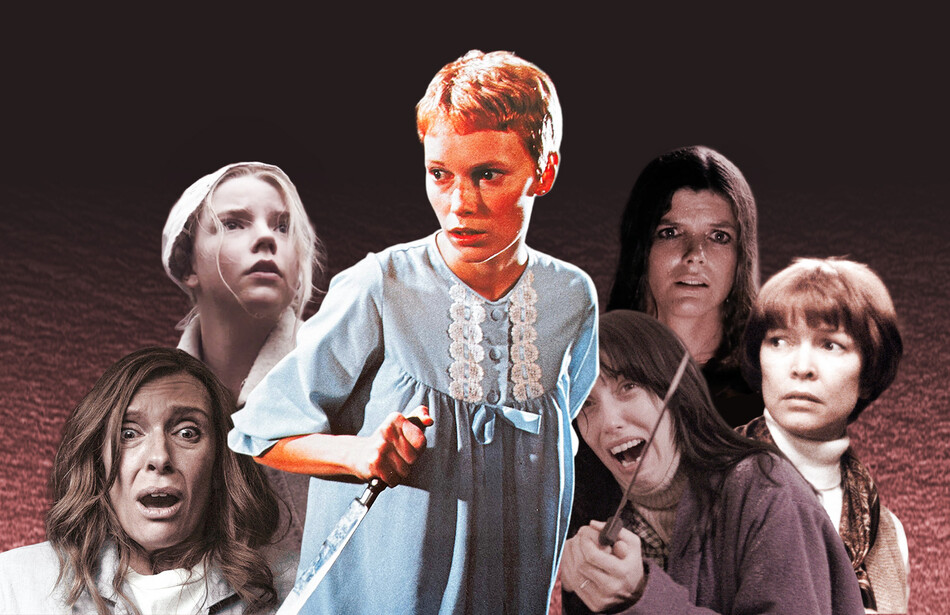
The film that popped immediately into my mind was The Exorcist from 1973. In that movie, there’s a male demon who enters a Georgetown mother’s home and takes possession of her preteen daughter. Over the course of the film, the mother, played by Ellen Burstyn, goes from being portrayed as a chic, independent, wealthy actress to walking around wearing a trench coat and scarf to hide her injuries from the demon — similar to a domestic-abuse victim. The Omen, from 1976, also deals with the effects of a demon on a family, particularly on the mother figure, and even includes a subplot about abortion and miscarriage.
The Stepford Wives, the 1975 horror-satire about a community of suburban women who are transformed into submissive housewife cyborgs, is another classic example of domestic horror. At the end of the decade, in 1980, you get The Shining, about the violent unraveling of a nuclear family holed up for the winter at a haunted hotel. There are a number of examples from the post-war period of the late 1960s through early ‘80s.
Why do you think this period produced so many domestic-centered horror films?
I think it has to do with several things. Second-wave feminism got going in the 1960s, so America became more aware of the women’s rights movement. In the middle of the decade, people were seeing news coverage of women who died because they couldn’t access abortion care. The end of the ‘60s saw the beginning of the anti-domestic-violence movement. Prior to this era, there was little mass, public discourse about domestic violence. These factors together triggered the development of what I call the domestic-horror genre.
The takeaways of the films from that era feel very modern today.
Yes, absolutely. Two of the films that I focus on in Scream with Me, Rosemary’s Baby and The Omen, directly inspired horror movies that were released in 2024. Apartment 7A is a prequel to Rosemary’s Baby. First Omen (a surprisingly excellent film) is a prequel to The Omen. Immaculate has both Rosemary’s Baby and The Omen as primary sources. These films would have been pitched around 2022, in the wake of the Dobbs decision.
There are other recent, original films that fit into the domestic-horror genre, such as Men from 2022 and Speak No Evil from 2024. Heretic, also from 2024, is interesting, because it’s about two women who get imprisoned inside a man’s home after they show up at his door to proselytize Mormonism. The film positions the concept of a house as dangerous to enter — even if it’s not their own house. I also think the casting is brilliant. The villain is played by Hugh Grant, who usually plays cute romantic-comedy leads. And initially, his character does come across as sweet and charming, but (spoiler alert) he turns out to be a horrendous predator. That was a ninja casting move on the part of the filmmakers, who captured a common trait of domestic violence: that offenders tend to look like “regular” people.
The directors and writers from the ‘60s and ‘70s that you focus on in Scream with Me were all male, yet you still consider some of their films feminist in their worldviews. How do you deal with that seeming contradiction?
One of the things I had to grapple with in writing Scream with Me was that I was assigning feminist meaning to some films that I knew were made not only by men, but by misogynistic men. Rosemary’s Baby was written and directed by Roman Polanski, whose transgressions are well known. Director William Friedkin has also been accused of abusive behavior, including toward actors Ellen Burstyn and Linda Blair, on the set of The Exorcist.
I don’t think we should forget about misogyny and abuse on the part of these filmmakers, but we can acknowledge the reality that art can exceed the intentions and politics of the people who make the art. Also, a film is made by a huge suite of people — and Rosemary’s Baby and The Exorcist were adapted from novels — so it isn’t totally ascribable to the agency and belief system of one person.
In the past two decades, we’ve seen the rise of many amazing female filmmakers who have made horror films like The Substance and The Babadook, as well as horror TV series like Widow’s Bay. Have you noticed a change in the tone and themes explored in the genre?
Yes. Since the 1970s, there’s been a pretty continuous uptick in the number of women directing films, including in horror. Julia Ducournau, the French director of Raw and Titane, is phenomenal. Apartment 7A, the recent prequel to Rosemary’s Baby, was directed by a woman, Natalie Erika James. She made a deliberate choice to amplify the anti-abortion logic of the story in a way that makes it unmistakable. The First Omen, which takes reproductive violence a lot more seriously than the original film, was directed by a woman, Arkasha Stevenson, who is excellent.
I think female directors are gravitating toward ideas surrounding abuse of women by the patriarchy and the dangers that can fall on women simply by being inside a home with a man. Women are coming into the horror space and reclaiming it, which I think is great.
I want to pivot and talk about your new book, Monstrous Bitch, which came out this month. Where did the idea for that come from?
It actually started with another course that I teach at Columbia, literature humanities (“lit hum”), the Core Curriculum class that all freshmen take. Around four or five years ago, we started including Mesopotamian literature on the syllabus. Digging into the subject allowed me to challenge a couple of foundational origin stories for female monsters and monsters in general. I’d long been interested in the idea of “scary women,” but that helped me build out the idea.
Can you speak more about that?
One thing I explore in the book is the vampire origin story. Traditionally, vampires and vampirism are assumed to originate somewhere murkily in Eastern Europe around the early eighteenth century. But it turns out that vampires in folklore are much older — they actually go back to ancient Mesopotamia — and they were usually female. Bram Stoker was inspired by Sheridan LeFanu’s 1872 novella Carmilla, about a lesbian vampire, when he wrote his 1897 gothic novel Dracula. Before Dracula, vampires were generally thought of as monstrous, blood-sucking women. The idea of the male, Lothario-like vampire came late to the party.
With Halloween coming up, what would you recommend for a costume? Any ideas from Monstrous Bitch?
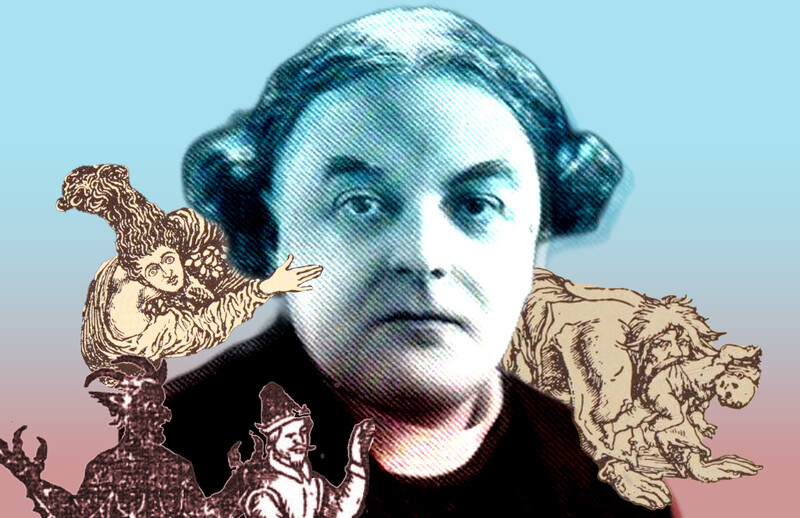
Don’t pick a typical Halloween witch. Stereotypical witch figures have been used in stories throughout history to justify killing women. Pick someone like the witch Erichtho from Ancient Roman literature. Erichtho was awesome; I talk about her a lot in Monstrous Bitch. She had scraggly hair and broken, bloody fingernails. She went around seducing young men and drinking the blood of the innocent — all sorts of bad stuff. Even the gods were afraid of her.
What are some of your favorite witch movies for Halloween?
There are a few witch movies from the twenty-first century that I would consider close to perfect. One is Robert Eggers’ 2015 film The Witch, about a family living in a haunted woods in Puritan New England. Another is Hereditary, Ari Aster’s 2018 film about a family with a haunted past. I also think that Suspiria (the 2018 Luca Guadagnino remake more than the original) is an excellent Halloween film. It’s hard to watch — I rarely assign it in class because it’s so gross. But it really understands the history of the demonization of women and explores how witchcraft could be re-theorized in a more positive feminist way.
I would also recommend The Substance, which isn’t directly about witches, but it very much deals with the horror trope of female monstrosity. One of the most powerful things about that film is that even though the main character, played by Demi Moore, is “monstrous,” she isn’t the real monster. The real monster is the patriarchal, corporate goon played by Dennis Quaid.
How are students responding to horror in 2026?
Man, they just love it. I think one reason is that the cinematic genre of horror has gotten smarter, more interesting, and more artful in the last twenty-five years or so. Horror was unequivocally great in the 1970s, but in my opinion, the era between the early ’80s and 2000 was weak. The Blair Witch Project, which came out in 1999, was kind of a turning point, and the genre has been mostly really good since then.
I think another part of it — and this is really sad — is that our students are existing in a global reality that is pretty horrible. We’ve got climate change, and many students have been in situations of domestic unsafety. Many have had or know someone who has had reproductive difficulties, so they resonate with the idea of reproductive horror.
There’s also been a rise in timely horror films that deal with identity categories, such as queerness. And horror has been a particularly productive lens through which to think about American racism in recent years. Jordan Peele is an absolute genius, and Get Out, I think, is one of the most important horror works ever made about entrenched American racism.
So I think that horror has developed an increasingly astute and sophisticated vocabulary for thinking about serious, intractable sociopolitical problems. Because of that, students are very, very eager to talk about it.