The Columbia-Educated Lawyer Who Helped Write the Declaration of Independence
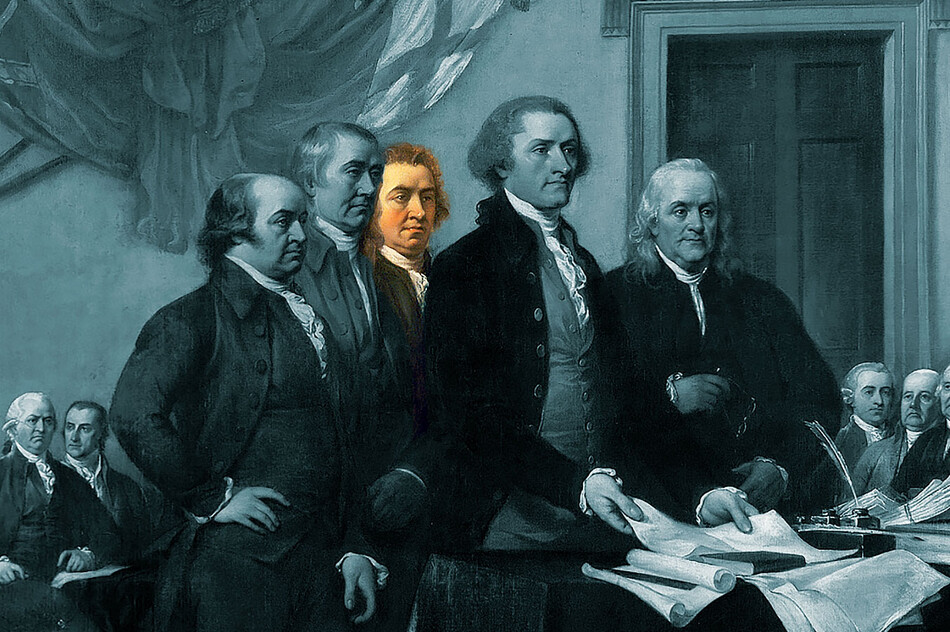
On June 11, 1776, with the American Revolution raging, the Second Continental Congress convened in Philadelphia and appointed five men to draft a statement declaring a break from Great Britain. This group, known as the Committee of Five, comprised lawyer and lead author Thomas Jefferson, of Virginia; lawyer John Adams, of Massachusetts; Postmaster General Benjamin Franklin, of Pennsylvania; judge Roger Sherman, of Connecticut; and lawyer Robert Livingston 1765KC, of New York.
Though only twenty-nine, four years younger than even the rising star Jefferson, Livingston was chosen for his legal acumen. His insights informed the document’s litany of abuses charged to King George III and its conclusion that “a Prince, whose character is thus marked by every act which may define a Tyrant, is unfit to be the ruler of a free people.” The colonies adopted the text, soon to be known as the Declaration of Independence, on July 4, and fifty-six delegates signed it. But Livingston, recalled to New York to draft the state constitution with his law partner, John Jay 1764KC, and his friend Gouverneur Morris 1768KC, missed the signing ceremony, and his name does not appear on the parchment.
Back home, he shuttled between New York City and his family estate, Clermont, in the Hudson Valley, where he lived with his wife and daughter, as well as a number of enslaved servants: Like most -liberty-espousing founders, Livingston was a slave owner, and as late as 1790, he held fifteen people at Clermont.
During the revolution he also kept tabs on the battlefields, using the new US Postal Service to send intelligence to General Washington (“The troops raised on Long Island, & which we have subjected to your Excellency’s command . . . may amount to about 800 men,” he wrote in August 1776). In 1777 the New York Convention of Representatives named Livingston chancellor, the highest judicial post in the province.
As chancellor, Livingston presided over the court of chancery, which handled cases involving restitution and sought to apply standards of fairness and conscience. And it was Livingston who, as New York’s legal authority, stood before George Washington on April 30, 1789, at Federal Hall in Manhattan and, Bible in hand, administered to him the oath of office of the first President of the United States.
In 1801, President Thomas Jefferson asked Livingston to be minister to France. Livingston resigned as chancellor and turned to the task of acquiring the port of New Orleans. As talks stalled, Jefferson sent Livingston and envoy James Monroe to Paris to bargain with Napoleon’s treasury minister. Negotiations ended unexpectedly in April 1803, when France offered not just New Orleans but the entire Louisiana Territory, 828,000 square miles from the Mississippi to the Rocky Mountains. The Americans agreed to pay $15 million, and voilà: The size of the US nearly doubled. “This is the noblest work of our lives,” Livingston wrote to Jefferson. “Today, the United States take their place among the powers of first rank.”
His service done, Livingston retired from public life in 1804 and set out in business. After having met inventor Robert Fulton in Paris in 1802, he bankrolled Fulton’s steamboat while gaining exclusive rights from the state legislature to run steamboats on the Hudson. In 1807 he and Fulton launched the North River, the world’s first steam-propelled commercial vessel, which took two days to go from New York to Albany. Livingston also pursued livestock breeding, starting with two pairs of merino sheep he had brought back from Europe. In 1809 he published Essay on Sheep, a manifesto of the “merino craze” (1809–1811) that gripped the Northeast when embargoes on British goods sparked demand for homegrown wool, a boom that added even more layers to Livingston’s wealth.
Livingston died at Clermont in 1813 at age sixty-six. Compared with others on the Committee of Five, his recognition is modest: New York and Kentucky each have a Livingston County; the Livingston Masonic Library, on West 23rd Street in Manhattan, is also named for him. Statues of Livingston stand in the US Capitol and in the New York Court of Appeals in Albany. At Columbia, generations of undergrads resided at Livingston Hall, which was changed to Wallach Hall in 1981. And, of course, his signature is on the Louisiana Purchase Treaty, housed at the National Archives.
The Declaration of Independence, which bears Livingston’s lawyerly stamp if not his name, stands as his most important contribution to the country. For while the Louisiana Purchase and the steamship greatly changed America, the Declaration, with its claims of natural rights, and its contempt for tyranny, defined it.