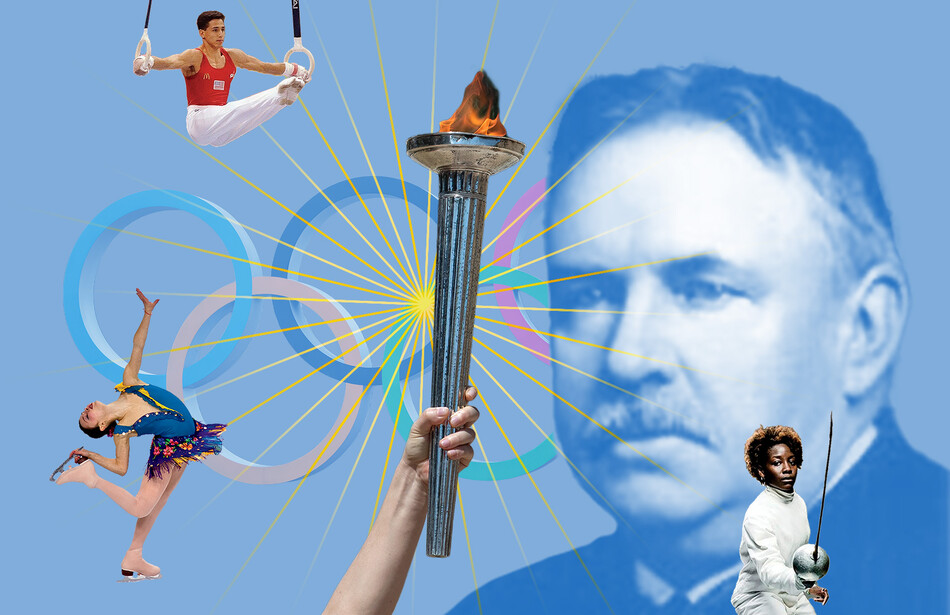
If medals had been awarded in 1896 for multitasking, William Milligan Sloane 1868CC might have taken the gold. That year, Sloane, a professor of French history, left what he called his “lucrative and honorable position” at Princeton to become head of Columbia’s history department; published the first of his four-volume biography The Life of Napoleon Bonaparte; and, as the US delegate to the fourteen-member International Olympic Committee, helped establish the first global, modern version of the Greek Olympic Games.
The Games began in 776 BC and were held every four years until 393 AD, when the Christian Roman emperor Theodosius I, regarding the Olympics as a paganist, Zeus-worshiping affair, abolished them, though some scholars contend that they fizzled for lack of finances. It wasn’t until 1875, when German archaeologist Ernst Curtius embarked on a massive six-year excavation of Olympia, the ancient Greek religious sanctuary and site of the Olympic Games, that a certain classical romance rose from the dust. By that time, Sloane was in Germany, earning his doctorate at the University of Leipzig and serving as secretary to George Bancroft, US minister to the German Empire in Berlin.
Meanwhile, in an affluent district of Paris, a twelve-year-old boy named Pierre de Coubertin was eagerly following news of the excavation in Greece, which would span his teen years. Young Coubertin was intoxicated by reports of the marvels unearthed at Olympia: the original Olympic stadium, the temples of Hera and Zeus, and thousands of sculptures, coins, and ceramics. The ancient world came alive to him, and the Greek ideal of mind-body-spirit harmony, as expressed through the Games, would guide him for the rest of his life.
Coubertin became an educator, and viewed athletic competition as integral to students’ personal development, believing that it fostered discipline, character, and self-improvement. He also recognized that sports could be an instrument of cooperation between nations. Having observed small, Olympic-like sporting events in England, Coubertin began envisioning a multisport event on a scale unimaginable to antiquity.
But he couldn’t make this dream happen alone. He needed a partner, an influential advocate, someone as driven, distinguished, and persistent as himself.
One day in 1888, in Paris, Coubertin visited the home of historian and philosopher Hippolyte Taine, a leading figure of French positivism whose works included History of English Literature and The Origins of Contemporary France. Taine had another guest that day — Professor Sloane of Princeton. Sloane and Coubertin struck up a friendship, and in 1889, shortly after the Eiffel Tower was completed for the Paris World’s Fair, the French government sent Coubertin to the US to survey athletics programs at US high schools and colleges and assess their benefits. Sloane, who was president of Princeton’s athletics advisory committee, acted as Coubertin’s guide and sponsor in America, and Coubertin gained an even fuller sense of the diplomatic dividends of international competition.
Coubertin’s big idea was taking shape. In November 1892, at a meeting of the Union des Sociétés Française de Sport Athlétiques, a sports governing body that Coubertin cofounded, he made his first public appeal to resurrect the Olympics. “Let us export rowers, runners, and fencers,” he said. “This is the free trade of the future, and the day that it is introduced into the everyday existence of old Europe, the cause of peace will receive new and powerful support.”
Coubertin returned to the US in 1893 to drum up American interest. The response was tepid — with one notable exception. “Nowhere did the idea for the revival of the Olympic Games meet with the enthusiasm it deserved,” Coubertin later wrote. “My kind friend William Sloane alone was wildly enthusiastic about the project.”
Sloane’s fervent support proved to be ample fuel, spurring Coubertin to organize the first Olympic Congress, held in June 1894 at the Sorbonne. Nine countries participated. The Congress established the International Olympic Committee — Sloane was the US delegate — and announced its intention to stage the first modern Olympic Games in 1896, in Athens.
The 1896 Games featured 241 male athletes from fourteen countries participating in forty-three events, including swimming, cycling, wrestling, and gymnastics. As founder and president of the American Olympic Committee (now the US Olympic Committee), Sloane organized a squad of fourteen men, mostly from Princeton and Harvard. Two Columbians also made the cut: Thomas P. Curtis, a student, and Charles Waldstein 1873CC, a forty-year-old Athens-based archaeologist who, on Coubertin’s behalf, had performed the critical task of persuading the Greek royal family to back an Athens-hosted Games — and was rewarded with a spot on the US team. Since the first Olympics, at least eighty Columbians are known to have participated, winning dozens of medals, including twenty gold.
Sloane traveled to Greece with the 1896 athletes, but gave away his tickets to the Games to two cash-strapped team members. The Americans dominated at Athens, winning eleven first-place silver medals (the gold-silver-bronze system would be instituted four years later). Thomas Curtis won the 110-meter hurdles event, while Waldstein, the oldest contestant at the Games, competed in rifle-shooting, and was one of two Americans to not earn a medal. Though Sloane was absent from the stands in Athens, he did attend the 1900 Games in Paris, which included female athletes competing in tennis, sailing, croquet, golf, and equestrian events. The next year, Sloane was offered the presidency of the IOC, but he deferred the honor to Coubertin.
The professor was busy enough on the “American Acropolis” of Morningside Heights, teaching, writing, speaking, and leading the history department. In 1916, after twenty years at Columbia, Sloane retired. Had history bent in a different direction, he might well have gone to the Olympics that summer in Berlin. But with Europe at war, the Berlin Olympics were cancelled — the first but not last time a global conflagration would preempt the Games.
As a scholar of French and Balkan history and the father of the US Olympic movement, Sloane, the son of an abolitionist pastor, took a keen interest in geopolitics. A strong defender of the “social order as represented by family, state, and church,” he assailed the “moral scourge” of “red radicalism,” and in his retirement letter to President Nicholas Murray Butler and the Columbia Trustees he praised the University for holding “the middle course of progressive conservatism in matters of faith and morals.”
Sloane was elected president of the American Academy of Arts and Letters in 1920. In 1925 he suffered a debilitating stroke, and, according to his friend and fellow traditionalist Henry van Dyke, a Princeton English professor, he spent his final years enjoying “his family, the visits of his friends, and long daily drives in the country.” Sloane, van Dyke wrote, “knew so much of books and men; his fund of stories, true or well-imagined, was so inexhaustible; his sympathy with good things was so wide and hearty, his detestation of bad things so frank, fearless and witty, that a talk with him ... was a joy to the heart and a liberal education.”
The last Olympics in Sloane’s lifetime were the 1928 Games in Amsterdam. There, some 2883 athletes from forty-six countries took part in 109 events covering fourteen sports. Women competed for the first time in track and field, and the Olympic torch was introduced.
Back in America, Sloane’s own flame was fading. He had another stroke, and on September 12, 1928, one month after the closing ceremonies in Amsterdam, Sloane died at his home in Bay Head, New Jersey, at age seventy-seven. Hundreds attended his funeral at the First Presbyterian Church in Princeton. Van Dyke officiated. A quartet sang hymns. One of the songs of praise, “How Firm a Foundation,” evoked, through a Christian lens, the spirit and valor of the Olympic Games that Sloane helped bring to the world:
When through fiery trials thy pathway shall lie,
my grace, all sufficient, shall be thy supply;
the flame shall not hurt thee; I only design
thy dross to consume, and thy gold to refine.