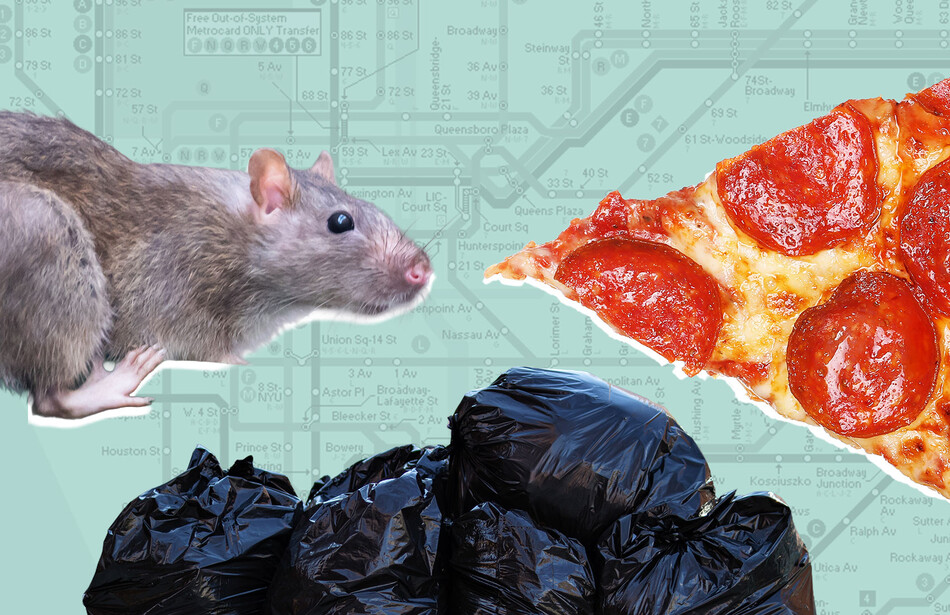
It was 5 p.m. and already dark by the time the tour group reached a park near the former Fulton Fish Market in Lower Manhattan. Suzanne Reisman ’00SIPA led the curious attendees to the edge of a small patch of woods, where they encountered holes in the ground, a discarded pizza slice, and a garbage can with trash scattered at its base. And then … movement!
“There’s one,” Reisman said, pointing. “That’s a big one. He’s a pound at least.”
The group peered into the shadows, ooh-ing and aah-ing as two rats ran up to the pizza slice, bit off a piece, then ran back into the dark. It’s what the group had come here for.
This was a typical sighting for the “Garbage and Rats in New York City” walking tour, a venture recently launched by Reisman. A graduate of Columbia’s School of International and Public Affairs and a former social worker, Reisman had felt burnt out after two decades of helping needy people in New York City. So she decided to make a change.
“It was nonstop depressing, seeing cuts of essential services,” she said. “I love walking tours, and I’ve been a licensed guide since 2009, so I thought, why not lean into that?”
A Chicago native, Reisman was already an expert on New York, having written the book Off the Beaten Subway Track, a guide to some of the city’s most unusual attractions. Rats and garbage fascinated her, especially after she read the 2005 book Rats: Observations on the History & Habitat of the City’s Most Unwanted Inhabitants, by Robert Sullivan.
To bolster her knowledge of the topic, Reisman attended several free, city-sponsored courses on sanitation and rat management, then launched the history and sightseeing tour in mid-2025. The two-and-a-half-hour walk through Lower Manhattan costs $45 per person and is offered up to five days a week. It has already received coverage in publications such as the New York Post and Time Out New York.
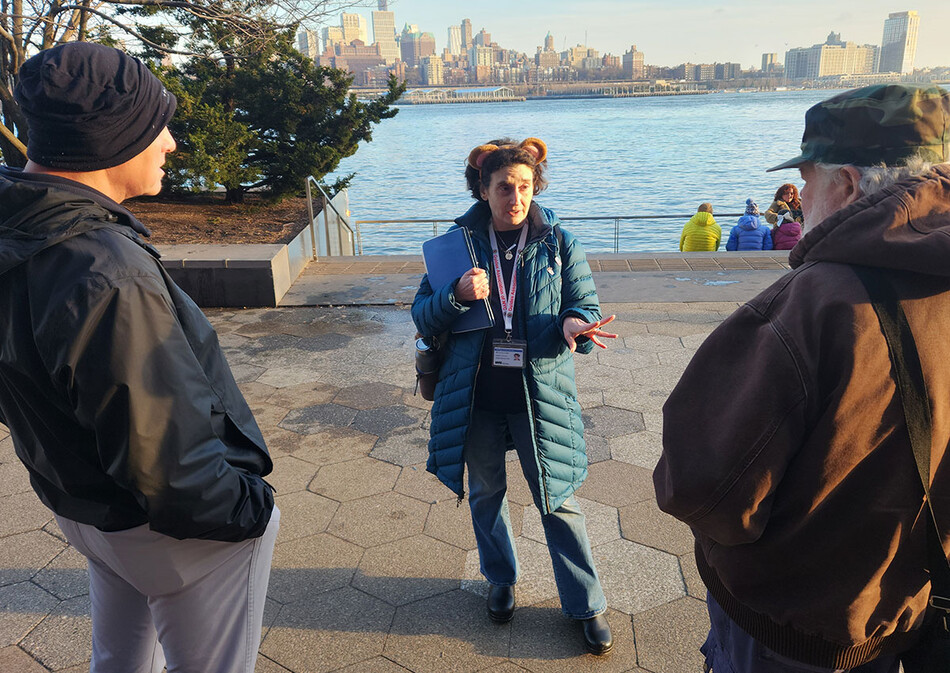
On a recent Thursday, Reisman met a group of three people at the corner of Wall Street and Pearl an hour before dusk (prime rat viewing time, Reisman says). The corner is the approximate location where the history of garbage and rats — the two have always been interlinked — began in New York City. Over the next two hours, the tour wandered over to the East River, up to the former fish market, and past numerous rat colonies as Reisman told stories of rodents and refuse. The guide was easy to follow: Reisman wears a rat-shaped backpack and rat ears for the tour.
The original Dutch settlers, Reisman explained, first began living in this part of the city in 1624. Sanitation was nonexistent: residents simply tossed their garbage out windows. When brown rats — also known as common rats, Norway rats, wharf rats, or sewer rats — arrived on ships from Europe, they found perfect feeding grounds.
By the mid-1650s, there were more than 5,000 people living in Dutch New Amsterdam, with pigs, goats, chickens, and horses often roaming free, Reisman said. Dead animals were left to decay where they fell. Human waste was dumped in gutters, along with food scraps and industrial waste from potting, tanning, and other trades.
“It was pretty fetid from Dutch times until 1895,” Reisman explained. “Our streets were virtually an open pit and sewer, and rats loved it.”
What happened in 1895? That’s when the city hired its first sanitation commissioner, who instituted New York’s first waste-management plan.
The plan helped to keep rats in check for seven decades. But in 1968, a nine-day sanitation strike resulted in 90,000 tons of garbage piling up on city streets. Then-mayor John Lindsay made the fateful decision to allow residents and businesses to put garbage in bags instead of Oscar-the-Grouch-style metal cans, and the rat population blossomed in the face of this new vermin smorgasbord.
Today, experts estimate the city’s rat population to be in the millions. A typical female rat can give birth as often as once a month and have up to twelve pups per litter, so it’s unlikely that rats will ever go away. Still, Reisman thinks the population could be controlled through the use of modern rat-proof dumpsters and garbage cans — something the city is already promoting and enforcing under the direction of New York City Council sanitation committee chair Shaun Abreu ’14CC — along with extermination techniques like dropping dry ice into rat holes, which asphyxiates them as they sleep. The city has even distributed rat birth-control pellets near trash sites.
A greater understanding among humans on the importance of properly discarding refuse would also help.
“People say we have a garbage and rat problem,” she said. “But really, we have a people problem.”