For all of life’s glorious diversity, its basic building blocks are stubbornly consistent from one organism to the next. Every living thing on Earth today — from fungi and fruit flies to oak trees and humans — is composed of the same twenty chemical compounds, called amino acids, which can be strung together to form hundreds of millions of distinct proteins. (A few organisms contain more than twenty amino acids, but none have less.) Many scientists believe that this biochemical architecture is essential for life, and that if any of those twenty amino acids didn’t exist, neither would we nor any of the plants or animals around us.
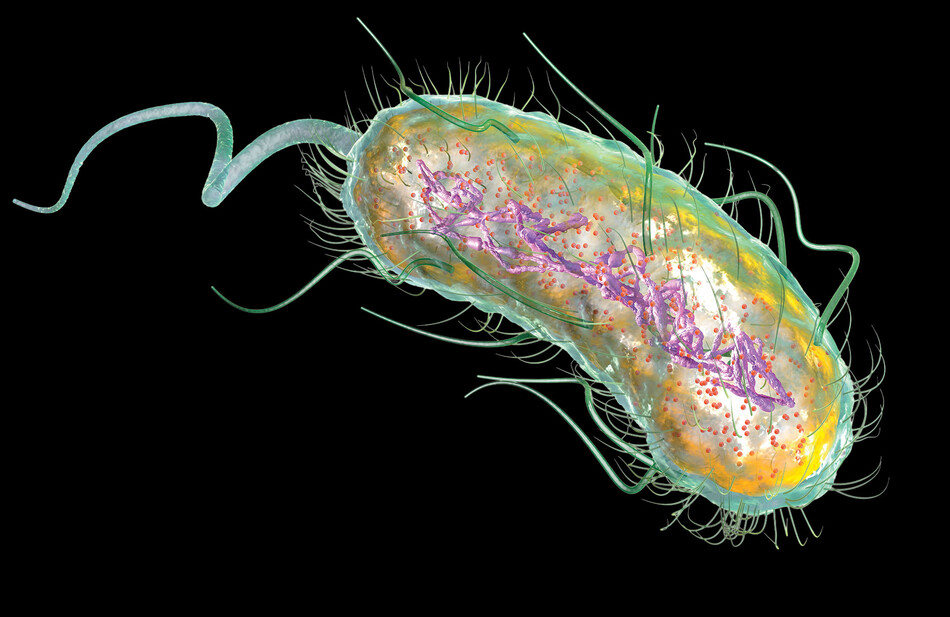
But now a team of scientists led by Columbia systems biologist Harris H. Wang has provided some of the first experimental evidence to suggest that life as we know it could operate with a simpler tool kit, and that if only circumstances had unfolded differently, evolution might have settled on a sleeker design. In a paper in the journal Science, the researchers describe having created a bacterium that thrives despite having only nineteen amino acids in some of its most critical components. Specifically, the scientists used AI models to genetically reengineer a harmless form of E. coli so that it lacks the amino acid isoleucine in its ribosomes, the free-floating mini-factories that produce all other cellular parts. The stripped-down ribosomes still churn out proteins that contain all twenty amino acids, so the rest of the bacterium operates with a full set, but the ribosomes’ ability to do the job shorthanded has been heralded as a promising first step on the path to creating an entire organism with a leaner biochemical makeup.
“The paper is a tour de force of synthetic biology,” Tom Ellis, a British genomic engineer who wasn’t involved in the study, told Scientific American. He praised the work for addressing “a really interesting question that’s fundamental to the origin of life on Earth.”
Wang and his colleagues first set out more than a decade ago to pare the chemical code of life down to nineteen amino acids. The Columbia scientists specialize in genetically engineering microbes for novel biomedical applications, such as monitoring the health of the gut microbiome and delivering cancer drugs straight into tumors, and they thought that a bacterium trimmed of one or more amino acids would make for an ideal vehicle. That’s because the specific DNA sequences that would ordinarily encode for an amino acid could be reassigned to carry instructions for new, synthetic compounds designed to function as living drugs or sensors.
“We knew that removing an amino acid would be extremely difficult,” says Wang, likening it to “writing a book without using the whole alphabet.”
The scientists zeroed in on isoleucine as a candidate for removal after observing in E. coli that nature occassionally swaps out the compound in favor of similarly shaped amino acids, valine and leucine, without causing much harm. Wang and his team then began the painstaking work of genetically removing isoleucine from dozens of E. coli ribosome proteins where it typically appears, and subsequently making lots of compensatory genetic tweaks that turned out to be necessary to ensure that those proteins continued to function smoothly. Their strategy showed promise — after a couple of years, the team had successfully reprogrammed a handful of the relevant proteins — but the work was so difficult and expensive that they eventually shelved it.
The Columbia scientists picked up the project again in 2021, though, when AI systems became capable of predicting which genetic changes were most likely to preserve the function of affected E. coli proteins. “Some of the solutions that the AI models came up with were surprising, things that we’d have never thought of,” says Wang. He notes, for example, that the algorithms sometimes proposed altering multiple DNA sequences in different parts of a protein in order to compensate for isoleucine’s removal.
Currently, Wang and his colleagues are working on plans to create a new version of E. coli that is entirely devoid of isoleucine. If successful, they say, the effort could have profound implications for biomedical science, opening up new avenues for targeted drug delivery and real-time health monitoring.
Evolutionary biologists are sure to be watching the Columbia team’s progress too. Until now, scientists could only speculate whether life with fewer than twenty amino acids is possible, and what the advantages and disadvantages of a simpler design might be. That’s because all living things on Earth today, and all species in the fossil record, appear to have descended from a bacteria-like organism that lived some four billion years ago and bequeathed to us its biochemical code. “But now, by reducing the number of amino acids in an organism, we can start to investigate the boundaries of cellular life in an experimental setting for the first time, rather than just theorizing about it,” Wang says.
He says that his team’s AI-driven approach to synthesizing cells promises a windfall of discoveries about human biology as well. “Part of what’s exciting about this research is that the AI models are starting to recommend to us genetic sequences and amino acid combinations that we can see clearly function, even though we don’t always know why they function,” he says. “That means the AI has the potential to reveal to us new things about how our bodies work, and how we could make them work better.”