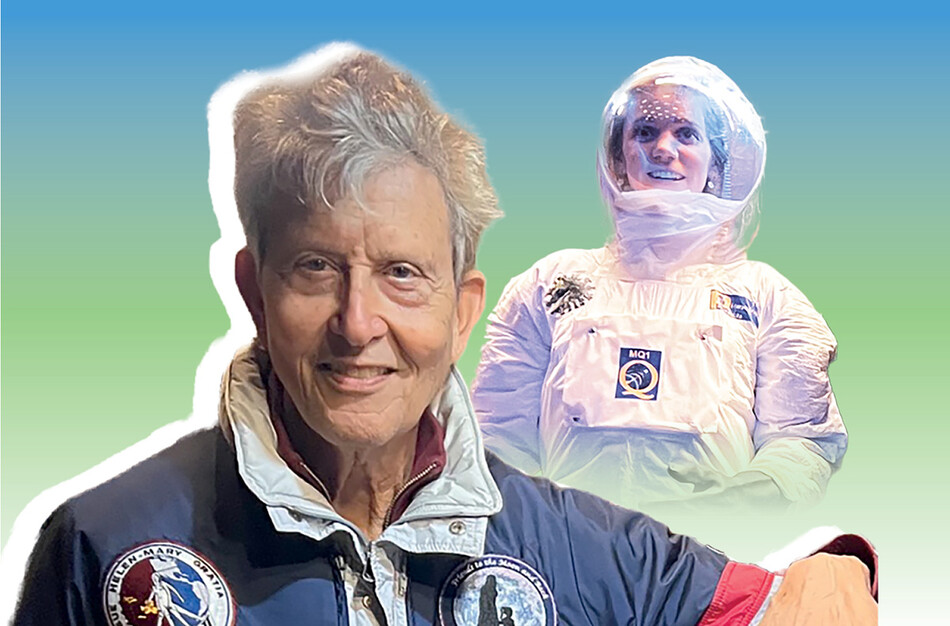
You can’t miss the threads running through the story of spacesuit designer Lawrence Kuznetz ’64SEAS ’65SEAS. He was a boy on Long Island when he saw War of the Worlds (1953), in which Martian invaders, bent on colonizing Earth, wreak destruction on human civilization. “That movie scared the bejesus out of me,” Kuznetz says.
A few years later, when his father’s Garment District belt-and-button factory was threatened by the invasion of the beltless, buttonless chemise, Kuznetz’s mother opened a nursery school. A parent of one of the students was science-fiction writer and aviation whiz Martin Caidin, and the teenage Kuznetz, at his mother’s urging, visited Caidin, who was helping NASA promote the Project Mercury launches. In his office, Caidin had models of Russian launch vehicles, and he filled Kuznetz’s head with dreams of a space-based career.
“Between the movie and Caidin,” says Kuznetz, “the die was cast.”
In graduate school for bioengineering, Kuznetz was drawn to the challenges of making spacesuits, and in the lead-up to the Apollo 11 moon mission in July 1969, he joined NASA. On the big day, he was at a Mission Control console in Houston, monitoring the life-support systems in the astronauts’ spacesuits as they stepped from their module into the scant lunar atmosphere.
Days later, the astronauts returned to Earth in the command module, for which Kuznetz had designed the ventilation system’s filter to trap microbes. This was in accordance with Article IX of the 1967 UN Outer Space Treaty, which requires space-faring nations to take measures to prevent pathogens from leaving and entering Earth. But when the capsule splashed down in the Pacific, Navy SEALs opened the hatch, releasing astronauts Armstrong, Aldrin, and Collins, and whatever else might have been in there. The team wiped down the spacesuits — and tossed the rags into the ocean.
“NASA pooh-poohed the idea of pathogens on the moon,” Kuznetz says. “But we’d never been to the moon, never sampled anything. We had no idea what the hell was there.”
It’s true, Kuznetz says, that the six moon missions went where there was no ice, which could harbor pathogens, but NASA’s current Artemis program, which aims to establish a base on the moon, “will go to places in permanently shadowed craters, where there’s likely to be embedded ice that could have come from anywhere. It could be anything.”
After the Apollo program ended in 1972, Kuznetz went to work on the Space Shuttle program, and in 1981, the year NASA’s first reusable spacecraft, Columbia, lifted off, he went on The Tonight Show and coolly outfitted Johnny Carson in the latest protective space couture. He grieved, like everyone at NASA, after the Challenger disaster in 1986. And when, in 1989, President George H. W. Bush called for a human mission to Mars, Kuznetz’s mind took flight. “Mars is a different world,” he says. “There could be pathogens there. Chances are that life could have taken hold and that there are microbes beneath the surface.”
Energized, Kuznetz did a postdoc at NASA’s Ames Research Center, in the Bay Area, publishing a paper on Mars spacesuits, and in 2012 he began teaching at UC Berkeley, where his first class was called Spacesuits for Mars. “I’ve never been adept at getting grants or funding,” he says, “so all this was on paper. And that’s how it kept on going — until the pandemic.”
By then, Kuznetz was working with spacesuit builder Cameron Smith, a professor at Portland State University. The system Kuznetz and Smith had devised for Mars involved Super HEPA filters, which can stop particles as small as 0.1 micron (smaller than the influenza virus). As COVID-19 swept the world, killing millions, Kuznetz had a flash: A COVID particle was bigger than 0.1 micron, which meant that his filtration concept could be worked into PPE — personal protective equipment. He and Smith quickly made a prototype.
The garment, intended for the general public, is white and weighs less than a pound. It is reusable and sterilizable — and, in Kuznetz’s vision, affordable, with a target price of $200. “I call it a ‘mobile quarantine suit’ because you can go anywhere with it.” Kuznetz believes that the further we get from the pandemic, the more people forget how difficult the isolation was. If everyone had a suit on hand, he says, there would be no need, in an outbreak, for 2020-style mass confinement.
Now he hopes to attract investors to get the venture off the ground. That’s the hardest part. He recalls working summers for his father as a teenager, pushing dress racks on Seventh Avenue, and his father telling him, “Whatever you do, don’t ever get involved in the schmatte business.” So much for that.
Yet it’s the War of the Worlds (spoiler alert) that really sews things up. The main character is Clayton Forrester, a scientist at the fictional university Pacific Tech in Northern California, who leads the effort to understand Martian technology and biology. The merciless extraterrestrials prove impervious to human weapons, and young Kuznetz, popcorn in hand, was transported when the Martians were finally stopped — not by bombs, but by Earthly bacteria, for which they had no protection.
This article appears in the Fall 2026 print edition of Columbia Magazine with the title "Spacesuits for Earthly Ills."