Lucia Aniello Hacks the System
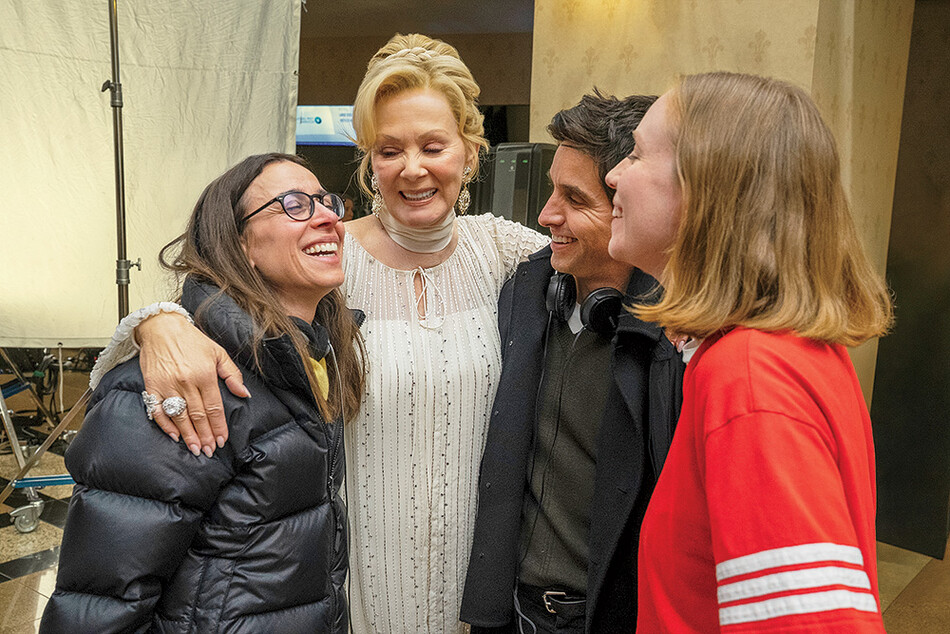
It’s late May 2026, and Lucia Aniello ’04CC is sitting onstage alongside the cast and co-creators of Hacks, the series finale of which just screened in front of a raucous Los Angeles crowd of 725 Emmy voters, crewmembers, and obsessed fans.
Aniello directed and co-wrote the last chapter of the Emmy-winning comedy centering on the unlikely bond between Deborah Vance (Jean Smart), a salty seventy-year-old Las Vegas comedian, and Ava Daniels (Hannah Einbinder), a cynical Gen Z comedy writer.
Seeing the episode on the big screen has been an emotional gut punch for its cast. Smart and Einbinder are each doing their best to hold back tears after the closing scene: a hopeful shot of Deborah and Ava walking arm in arm along the Vegas Strip, as Barbra Streisand and Judy Garland’s buoyant 1963 rendition of “Happy Days Are Here Again” plays over the final frame.
“I was so excited because it was a … duet,” Smart says to the audience about the poignant song choice, while lovingly brushing Einbinder’s arm. And with that, her costar is sobbing.
Sensing that the conversation is veering a little too maudlin, Aniello jumps in. “It’s a comedy!” she declares, and the crowd erupts in laughter.
Aniello is doing what she’s done best for the past twenty-plus years: seamlessly bringing funny back into the frame.
For five seasons, Hacks reflected and sometimes even predicted some of Hollywood’s most pressing realities: ageism, misogyny, the wrath of cancel culture, the threat of AI, and, in an especially prescient and painful storyline, corporate meddling in late-night TV. But it never forgot to make us laugh.
Hacks also won over the industry it so often pointedly skewered: At press time it had amassed eighty-nine Emmy nominations and twelve wins, including Aniello’s 2021 trophy for comedy-series directing and a surprise Outstanding Comedy Series victory in 2024, when the show unseated the incumbent, FX’s The Bear.
“Please support comedy — it speaks truth to power!” Aniello implored viewers in her Emmy acceptance speech as she celebrated alongside fellow creators Jen Statsky and Hacks actor Paul W. Downs (“Jimmy”), who also happens to be Aniello’s husband.
“You can see the literal shock on our faces,” says Aniello, now in the living room of her and Downs’s Hollywood Hills home. She’s pointing to a framed black-and-white photo on a side table that shows the Hacks creators gleefully and incredulously exiting the Emmy stage in 2024, golden statuettes in hand.
It’s five days after the tearful Hacks finale event, and Aniello is curling up on a beige couch accented by squishy green pillows. She has traded her strappy tangerine-colored dress from earlier in the week for a comfy all-black ensemble and Ugg slippers; her brown hair is tossed into a loose ponytail. Downs is in the kitchen nursing a cup of coffee as their four-year-old son giggles in the background.
“He actually had two jokes in Hacks this season,” she says proudly of their son. “When [the TV executive to whom Ava pitches a show] says, ‘I didn’t like it … I loved it!’ — he says that all the time. And when Deborah tells Ava in Paris, ‘You shouldn’t talk with your mouth full,’ that’s something he says too.”
Aniello and Downs seem to be acing what many married collaborators find to be a precarious intersection of work and family in Hollywood, or in any business, really. For this, Aniello credits some powerful role models: her own parents.
Aniello was raised in Hadley, Massachusetts. Her Italian American mom and Italian dad (he immigrated at seventeen) had met in Boston and vacationed in Italy after getting married. Aniello was actually born in the town of Anzio, just outside Rome, because her mom and dad had extended their honeymoon. “They won a lot of money gambling in Italy, so they stayed longer,” Aniello says with a laugh.
The couple ran restaurants together in Amherst, which offered Aniello and her two siblings front-row seats to the art of stress management. “I watched them figure out how to be business partners. I also learned how to be a boss,” she says, noting that restaurant work and running TV shows require similarly rigorous multitasking.
When she wasn’t helping in the restaurants, Aniello was likely playing tennis, an activity she started before she was three years old. Though her parents had never played, they saw tennis as a ticket to greater opportunities. The sport became so central in Aniello’s life that the self-described “pretty good but not straight-A” student dropped out of high school after tenth grade and earned her GED so that she could play tennis full-time. And after feeling “disillusioned” by high school counselors who assumed she’d stay local for college, Aniello also wanted more time to consider her future.
“I loved UMass, but I didn’t connect with the idea that ‘this is the kind of student you are, so this is the kind of school you’re going to go to,’” she says. “I didn’t feel understood at that time by the world around me.” Aniello spent two years at Holyoke Community College nearby while also committing to tennis “in a more serious way.” She dreamed of going to school in New York City, and soon, Columbia emerged as her top choice.
Aniello arrived at 116th Street and Broadway in September 2001 as a transfer student and lived in Wien Hall alongside other transplants. Her days were packed with trips uptown for tennis practice (she became the team’s co-captain her senior year) and coursework for her film-studies major. The latter connected her with her most meaningful academic mentor, the iconic film critic and historian Andrew Sarris ’51CC, ’98GSAS. She recalls an early bonding experience on the harrowing morning of September 11, 2001, as a crowd of students gathered fearfully around a TV in Sarris’s office. “I really loved him,” she says wistfully of her professor, who passed away in 2012.
While Aniello had a passion for pop culture, she didn’t yet have a clear vision for her future. “Film studies was adjacent to what I thought I wanted to do, which was maybe be a curator, critic, or documentarian,” she says, recalling a stint working on interstitial music videos for a student-run Columbia TV station. She chose to write her senior thesis about her favorite movie, Back to the Future, and how time-travel movies often transcend their genre because they address a deeply human desire to heal familial or romantic love.
It did not go over well with her thesis adviser, Annette Insdorf. The experience would serve as preparation for future Hollywood pitch meetings: Sometimes people in power simply don’t connect with a writer’s vision.
“As brilliant as she is, I don’t think she really took to me,” says Aniello. “She made it clear that there were students she felt were filmmakers of the future, and I was not one of them. And that’s fine!”
Does she think Insdorf’s mind has since changed, considering her success?
“Honestly? I doubt it. She’d probably say, ‘I don’t remember who that is,’” Aniello says, laughing.
That minor angst aside, Columbia offered Aniello a sense of belonging that had previously eluded her. “It was perfect because I could be artsy with my film friends, fratty with my sorority, and sporty with my tennis team,” she says. “And I could party a lot!”
Regarding the last item, Aniello has particularly fond memories of a summer spent living in the Sigma Tau Delta house, on 114th Street between Broadway and Amsterdam. “Every day I’d get a Nussbaum and Wu chopped salad and a Diet Coke, smoke weed, and watch Sex and the City with my friends,” she recalls with a laugh.
After graduating in 2004, a feat she accomplished in just three years, Aniello coached tennis at Hamilton and Colgate colleges in upstate New York. She also worked part-time at a video store, where she consumed movies nonstop. It was during this time that she took her first earnest stabs at writing scripts. By January 2005, she’d moved back to New York City because she wanted to write, perform, and make comedy like her idol, Amy Poehler.
“I was that person waiting in line overnight outside 30 Rock for Saturday Night Live tickets,” says Aniello of her “obsession” with the comedy star, which led her to join Upright Citizens Brigade (UCB), the venerable improv troupe cofounded by Poehler. Aniello says she was drawn to improv because of its focus on collaboration. “I learned how to make comedy with other people,” she says. “If you want to be a showrunner or an actor, take improv. It’s very humbling.”
Aniello’s UCB tenure yielded some life-defining relationships: There she met writer-performers Abbi Jacobson and Ilana Glazer, with whom she’d later collaborate on Comedy Central’s Broad City. She also met Downs at UCB. By 2007, the two were dating.
By this time, Aniello had a day job at Lifebooker, a Groupon-like company, which helped fund her and Downs’s burgeoning slate of digital-comedy videos. Armed with borrowed cameras, self-taught editing skills, and a coterie of original characters, the duo created an impressive digital footprint on YouTube and other platforms under the moniker Paulilu.
When Glazer and Jacobson were ready to staff their New York stoner-buddy comedy Broad City (which by then had landed none other than Poehler as its executive producer), they told the network they wouldn’t make the show without Aniello.
Though still untested in TV, Aniello proved her mettle as a director, writer, and executive producer. Also featuring Downs as a writer, producer, and actor (“Trey” the trainer), the series ran for five seasons and created a blueprint of sorts for the couple’s organically inclusive worldview. “For us, this is how we see the world: filled with beautiful oddballs and weirdos," says Aniello.
In 2017, during Broad’s run, Aniello logged another milestone: She became the first woman in twenty years to direct an R-rated comedy, Sony’s Rough Night. The bachelorette-party-gone-awry romp, which Aniello co-wrote with Downs, starred Scarlett Johansson. It earned mixed reviews and just under $50 million at the box office.
“After it became a ‘Scarlett Johansson movie,’ it wasn’t the little indie we’d hoped to make,” says Downs, chiming in on his way upstairs. “The marketing also didn’t suggest it was as dark as it was,” he says, referencing the film’s grisly (but still funny) murder subplot.
“I also think I’d become used to spending more time with characters, in our web videos and Broad City,” Aniello says. And, she admits, “when the reception for Rough Night didn’t meet my expectations, it really shook my confidence.”
But it wouldn’t be long before critics changed their tune about Aniello: She, Downs, and fellow Broad City writer Jen Statsky conceived of Hacks in 2015, and six years later it premiered on HBO’s newly minted streaming service, Max, to gangbusters reviews.Critics universally hailed the show for the fresh and relatable Zoomer-versus-boomer rapport between Deborah and Ava, which evolved into a rousing love letter to artistic soulmates.
“The result of having a successful show is the ability to foster a community of filmmakers who get to tell their stories the way they want to tell them.”
Despite the show’s immense critical success (in addition to the Emmys, Golden Globe and Peabody award statues adorn the shelves of Aniello’s living-room cabinet), she doesn’t spare herself a dose of self-criticism. “There are episodes I see now and think, ‘I should have blocked that scene differently,’” she says. “To be honest, I find directing painful because I care so much about the product and the story. Because of that, I put a lot of pressure on myself.”
As she mulls what comes next (she, Downs, and Statsky have numerous projects in the works), Aniello reflects on the twenty-fifth anniversary of starting her artistic journey and how she has — and hasn’t — changed since she first arrived on campus.
“I loved Columbia, and I think I’m a more evolved version of who I was then,” Aniello says. “I used to talk a lot about wanting power — so much that my friends would make fun of me! But what I’d wanted was to work without anything stopping me. And the result of having a successful show is the ability to foster a community of filmmakers who get to tell their stories the way they want to tell them. That’s what power means to me now.”
There is an added layer of meaning in Hacks and its legacy that fills Aniello with immense pride. It’s the same truth she experienced working in her parents’ restaurants, playing tennis at Columbia, debating film theory with Sarris, and braving the boards at UCB.
“Making Hacks cemented for me that the best work comes from collaborating,” she says. “And that’s what the show was literally about: Collaborating makes you a better artist and a better person.”