How Do You Memorialize a Mass Tragedy?
Clifford Chanin ’77JRN, ’80SIPA can tell you exactly what he was doing on the morning of September 11, 2001: He knows that when the first plane struck the World Trade Center, hitting the North Tower at 8:46 a.m., he was listening to the radio while getting ready to leave the house, and that when the second plane struck the South Tower at 9:03 a.m., he was in his car trying to get onto the Brooklyn Bridge. He remembers the police cars and the screams and the smoke across the East River, and he remembers going to meet his three kids after they were released early from school. “The dust was blowing to Brooklyn,” he recalls. “It was foggy and hazy, and all of a sudden, I saw my kids emerge more clearly, and I thought, ‘This is what it’s like to be at war.’”
Chanin is the executive vice president and museum director of the 9/11 Memorial & Museum, an institution that takes the slogan “never forget” very much to heart. Chanin’s job is to keep the events of 9/11 in public memory and to tell the story of what exactly happened on the day a coordinated terrorist attack killed nearly three thousand people, transformed a vibrant patch of Lower Manhattan into a heap of rubble, and thrust the United States into a decades-long “war on terror” that still reverberates today.
The day’s violence was unusual, Chanin notes from a conference room in the museum’s basement, before leading a walk through the exhibit highlights, because people watched it play out in real time, on television, for 102 minutes. “There had never been an event like this, one that was transmitted around the world to people who understood that history was changing in front of their eyes.”
Twenty-five years later, the bustling plaza in the shadow of One World Trade Center bears no trace of carnage and ruin. But the 9/11 Memorial — two square sunken waterfalls built into the original foundations of the Twin Towers, with the names of the victims engraved along the perimeters — offers a sobering reminder of what happened there. Inside the mostly underground museum, a 110,000-square-foot cavern that once housed part of a commercial complex containing a shopping mall and parking garage, Chanin points out the raw bedrock and steel structures that supported the World Trade Center’s seven-building complex. “The architecture frames the visit and has a lot to do with the success of the experience,” says Chanin.
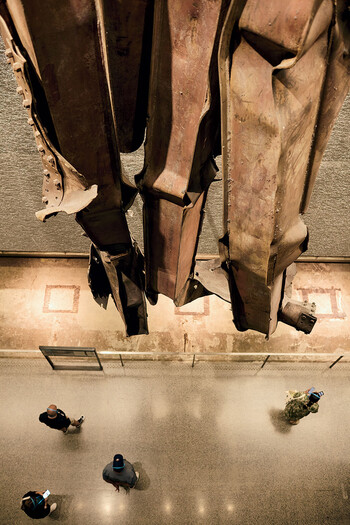
The artifacts on display include a fragment of the North Tower’s antenna found in the wreckage and part of a staircase that helped survivors flee the World Trade Center’s elevated plaza. “This is what we call impact steel, where the plane entered the building,” says Chanin, pointing to a large, mangled cluster of three rusted beams mounted to a wall like an abstract sculpture. “This was located on the north face of the North Tower, between the ninety-sixth and ninety-ninth floors. It’s 8:46 a.m. frozen in time.” Along with a photo of nearly every person killed in the attack, these elements of the main exhibit are intended to bring visitors back to that fateful day.
Decades before 9/11 changed New York, Chanin grew up in Kensington and Canarsie in Brooklyn and attended Samuel J. Tilden High School, where he edited the school newspaper. After majoring in government at Wesleyan University, Chanin received a Thomas J. Watson Fellowship to conduct a one-year independent study abroad. His chosen project was an oral history of Holocaust survivors who had gone back to Europe instead of settling in places such as the United States or Israel.
After his return, Chanin enrolled in Columbia’s Graduate School of Journalism. “The journalism degree was an opportunity to really learn how to talk to people, ask them questions, and listen to their answers,” he recalls. “Professors would send us out into the city to do our assignments while we figured out: How do you identify the details that convey the story? What are you listening for, and how do you frame it?”
To complement his journalism studies with a more traditional academic program, Chanin pursued a second master’s degree, at the School of International and Public Affairs, with a concentration in Soviet studies. “The folks who were teaching those classes spoke from such an incredible well of knowledge and experience,” says Chanin. “Both Columbia programs showed me the possibilities of what I could do, seeing how faculty and other experts had made the most of their specialties. I think that aspect impressed me even more than the immediate subjects.”
Chanin did end up pursuing a career in journalism, covering politics and other topics, then spending two and a half years as an assistant press secretary under mayors Ed Koch and David Dinkins. But in 1990, he pivoted back to international affairs by joining the Rockefeller Foundation, the humanitarian and cultural nonprofit founded in 1913 by philanthropist John D. Rockefeller Sr.
As a program officer with Rockefeller, Chanin traveled the globe to examine what at the time was a looming but underestimated issue: a surge in religious fundamentalism coupled with economic disadvantage in the Muslim world. “I helped start a program on the emergence of different voices across Muslim societies, and the challenges of what we might call the ‘identity politics’ of the Islamic revival,” says Chanin, who spent time in the Middle East, Asia, and Africa, absorbing a wide range of perspectives. “One of the things we did was try to create a network of institutions across regions that had different languages, histories, and concerns but were all wrestling with similar situations.”
During his travels, Chanin noticed a common thread across regions and cultures. “In many of the Muslim countries, there was this focus on history and traumas of the past,” he says. “I became very interested in looking at how societies in general remember mass violence, whether through public debate, creative works, or monuments and other constructions.” That curiosity took Chanin to sites such as Holocaust memorials in Europe, Cambodia’s Tuol Sleng Genocide Museum, and Gorée Island, in Senegal, a former hub of the Atlantic slave trade and now a UNESCO World Heritage Site. In every country, he saw a similar dynamic: Creative people had embarked on projects that helped process these mass tragedies. “The responses took different forms and different media,” he says, “but this seemed to be a universal phenomenon.”
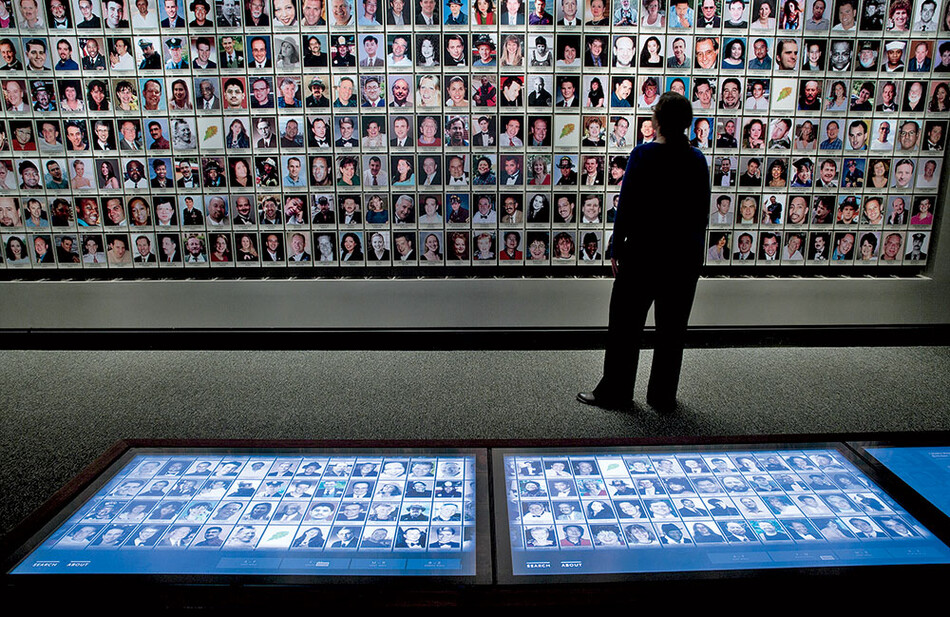
Chanin left Rockefeller as an employee in 2000, but he received a grant from the organization to start an initiative called the Legacy Project, a nonprofit that documented how societies around the world deal with collective memory of conflict and mass violence. Less than two years later, al-Qaeda jihadis attacked the World Trade Center and the Pentagon, and suddenly, all the geographic and subject expertise that Chanin had honed at Rockefeller was converging on his doorstep.
“Within days of the attack, people started talking about a memorial and what it would be, and I was drawn to try to contribute something,” he says. Chanin signed on to the memorial and museum development project in 2005 as a consultant during the planning phase, and he eventually joined full-time, overseeing programming. Literally built on ruins, the 9/11 Memorial opened in 2011, followed by the museum in 2014. “The project itself is an artifact of the community response to the event, a demonstration of the resilience,” says Chanin, who stepped into the role of museum director in 2022.
“Cliff has been my go-to person for anything concerning the overall operation,” says Jeh Johnson ’82LAW, a member of the 9/11 Memorial & Museum’s board of directors who is also a co-chair of Columbia’s Board of Trustees. “He has dedicated his career to the memory of 9/11, and the organization is better-off as a result.”
Johnson, too, was shaped by the day the towers were hit. An attorney who had served as general counsel for the Department of the Air Force under President Bill Clinton, he was working in a Midtown Manhattan law office on September 11, which happens to be his birthday. “After that, I rededicated myself to returning to national security,” he says. In 2009, Johnson was appointed general counsel for the Department of Defense by President Barack Obama ’83CC, and from 2013 to 2017, he held the cabinet position of United States secretary of homeland security. “It’s important for not just Americans but the international community to remember how tragic and transformational 9/11 was,” says Johnson. “I joined the board of the memorial and museum to help ensure that we never forget.”
For Chanin, memorializing a catastrophe such as 9/11 means making it relatable to the general public. “Today, a third of the population of this country was born after 9/11 or doesn’t have a memory of it,” he says, while walking through an exhibition of phone recordings and flight maps from the morning of the attacks. Chanin invites visitors of all ages to imagine: “On a normal day, you are put in a situation suddenly — literally out of the blue, in this case — where the stakes of life and death are all that’s in front of you, and the only questions are whether or not you can get out, whether or not you can help others.”
“Today, a third of the population of this country was born after 9/11 or doesn’t have a memory of it.”
Since opening more than a decade ago, the museum has expanded its vision from the day itself to cover some of 9/11’s long-term impacts. Exhibits now include, for instance, the scale model of Osama bin Laden’s compound that the Pentagon used to plan its 2011 assassination raid, as well as a display on the toxic dust that continues to plague first responders with health problems (around 1.8 million tons of debris were removed over nine months, creating an “environmental catastrophe” for the neighborhood, Chanin notes).
The site has also emerged as an important pilgrimage spot for emergency workers and civil servants. As part of their training programs, the FDNY, NYPD, FBI, and Port Authority Police Department periodically bring in new recruits for ceremonies on the memorial plaza and tours of the museum. “We never imagined that we would be given the responsibility and privilege to tell this story to future firefighters and other rescue workers who are stepping into the shoes of those who responded on that day,” says Chanin.
This fall, to commemorate twenty-five years after the attacks, the museum is presenting several new exhibitions: one on individuals who were inspired by 9/11 to pursue acts of service, and another on comic books and graphic novels tied to the tragedy. As in past years, the organization will be holding a ceremony in which the names of the day’s victims (2,977 total) are read aloud, and two massive light beams will be projected into the sky as ghostly reminders of the towers that once stood. The museum will be releasing a new half-hour film of first-person accounts of 9/11, including recollections from people who lost a parent in the attacks, and a virtual chat session will invite kids across the country to submit questions about the film (last year’s event saw around a million participants, Chanin says).
Unlike the many New Yorkers who avoid revisiting that September day (a large percentage of museum attendees are from out of town), Chanin isn’t weighed down by the gravity of the event that is central to his job. “Some days it strikes me differently than others, but what we do here is such a profound and moving experience for visitors that I find it enriching in ways that I never would have imagined,” he says after passing through a gallery where short videos remembering individual victims are projected onto a wall. “Being part of this story is to experience all aspects of humanity. There aren’t a lot of places where you go to work and that happens.”
This article appears in the Fall 2026 print edition of Columbia Magazine with the title "The Memory Collector."