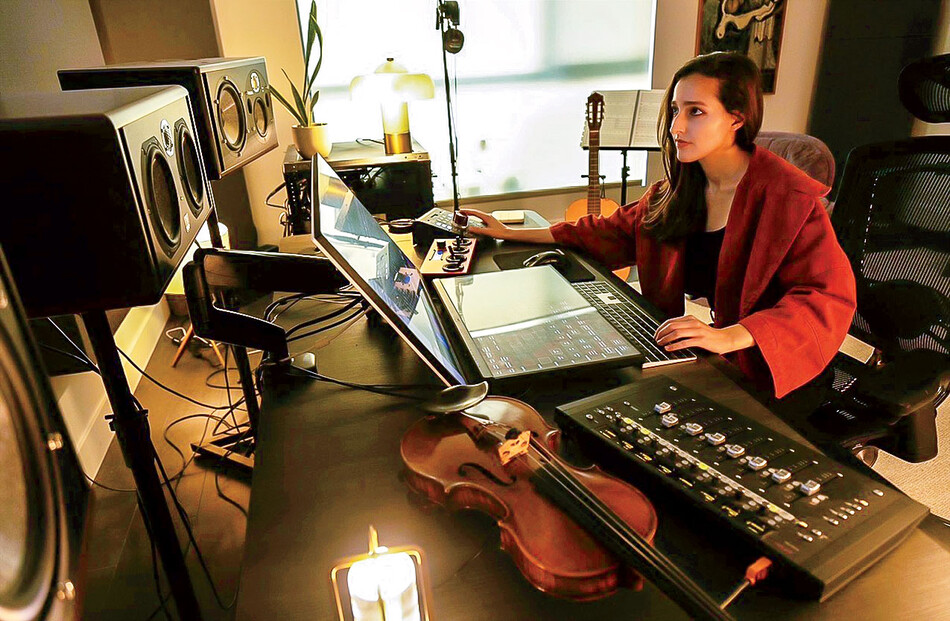
If you’ve ever watched the BBC nature show Planet Earth III or the 2025 Netflix crime series The Beast in Me, or played the virtual-reality game Alien: Rogue Incursion, then you’ve heard the music of Sara Barone ’17CC.
As an Emmy-nominated composer who works on a wide range of media projects out of her Los Angeles studio, Barone is attuned to the art of creating mood through music, conveying everything from the awe of entering the world’s largest cave in Planet Earth III to the high tension of a fight scene in the German action thriller Exterritorial. “What bridges all of these genres is that you’re trying to tell a story,” Barone says.
When writing for film or TV, Barone typically receives a rough cut and comes up with corresponding music, brainstorming themes and melodies at her piano. Games are less linear. “You watch videos, play the game yourself, and work with an audio lead to create a breakdown of the types of music needed to enhance player immersion,” she says.
Barone, who grew up playing classical piano, started to pursue media composition while she was a Columbia undergrad majoring in music. “Being in New York and having access to a lot of up-and-coming filmmakers and short films being created took me deep into that rabbit hole,” she says. As one of the few composition students in her cohort who was seriously interested in scoring, Barone found mentors in professors Zosha Di Castri ’14GSAS and David Adamcyk. “They really gave me the encouragement and confidence to pursue this crazy career,” she says.
This year, Barone has been busy adding to her eclectic portfolio, working on an indie feature film and another sci-fi video game. R.J. Decker, a detective series that she scored, with frequent collaborator Sean Callery, premiered on ABC and Hulu in March. “With the show being set in Florida, the score has influences in Latin music and blues,” she says. “It’s fun and quirky but also has dramatic turns that we had to convey sonically.”
Having worked in Hollywood for nine years now, Barone has witnessed the industry’s unsettling shifts, from the reduction in projects being green-lit to the looming impacts of AI. It’s harder today for young composers to break onto the scene, she says. “I’m really lucky that these past couple of years have been busy.”
This article appears in the Spring/Summer 2026 print edition of Columbia Magazine with the title "Sound Effects."