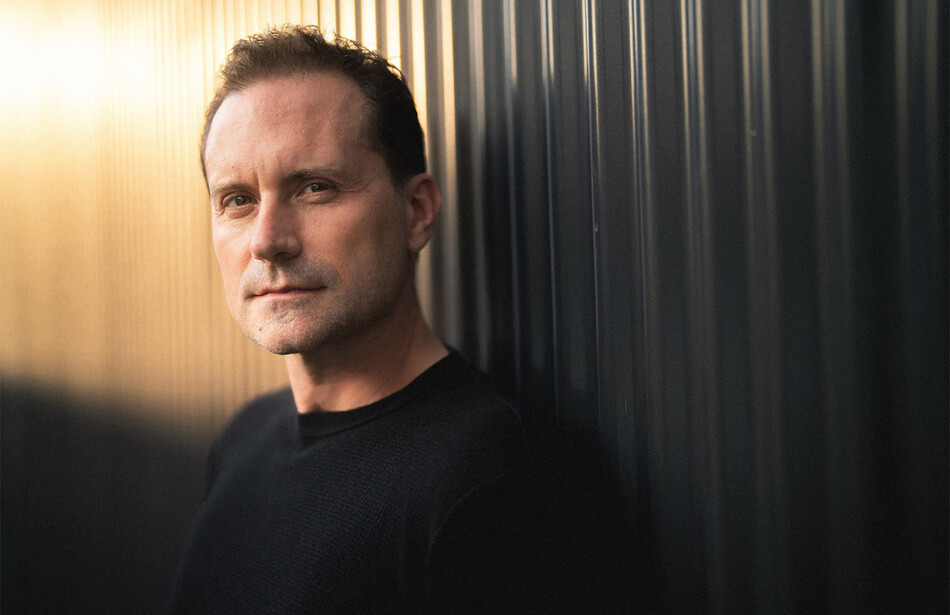
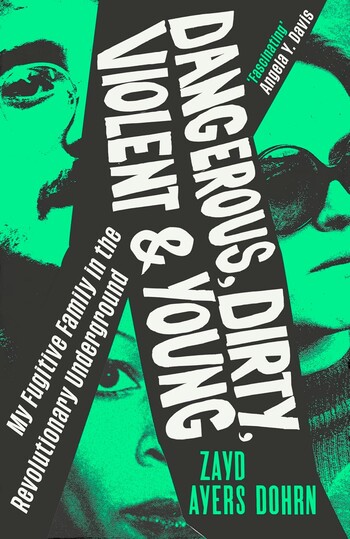
Playwright and filmmaker Zayd Ayers Dohrn ’06GSAS is the son of Bernardine Dohrn and Bill Ayers ’87TC, radical activists who, as leaders of the Weather Underground, spent much of the 1960s and ’70s engaged in armed resistance against the government. In his new book, Dangerous, Dirty, Violent & Young, Dohrn recounts a childhood spent partially on the lam, and wrestles with his parents’ ideals and the incredible risks that they took to act on them.
You’ve been a writer for many years, but you’ve never written about your family before. How come?
Well to start, I’ve always been a fiction writer and playwright. I never thought of myself as a journalist or memoirist, so it was easy to put my family story in a different sort of box, separate from the work that I was doing. And family stories are messy and complicated and difficult — mine arguably more so than others. Most people’s childhoods were not also crime-scene investigations.
Why did this feel like the right time? What was the evolution of the book?
During the pandemic, I was isolated from my parents, as most people were. My mother had just turned eighty, and I began to wonder how much time I would have left to dig into some of our family stories. Because my parents spent so many years as fugitives, they were wary of any kind of recording device; we didn’t even have photos or letters from my early childhood. I wanted a better understanding of that time, for myself and for my own children.
There was also a timeliness to it. In the wake of George Floyd’s death, protest movements were amping up across the country. People were clearly reckoning with a lot of the same kinds of issues that inspired my parents to become activists, particularly race and police violence.
Those early conversations with my parents and their friends became the foundation of my podcast series, Mother Country Radicals, which came out in 2022. But after the podcast aired, I actually started to learn a lot more about my family. People reached out wanting to talk for the first time, to share photos and documents, and I got access to a huge amount of FBI files that I’d been trying to get for a long time. All of that really laid the foundation for the book.
You mentioned your own children. How did fatherhood impact how you thought about your childhood and the choices that your parents made?
My wife, Rachel DeWoskin ’94CC, and I had our daughters when I was in graduate school for English and comparative literature at Columbia, and in many ways that was an echo of my own childhood. I was also raised for many years in Morningside Heights and Harlem while my dad studied at Teacher’s College. Some of my earliest memories are of playing on campus. So it was easy to draw parallels and start to think for the first time about the risks that my parents took not only for themselves but for their kids as well.
Kathy Boudin ’07TC — the mother of my adopted brother, Chesa — spent much of her life in prison for her role in a robbery that resulted in the deaths of three people. When she got out of prison in 2003, Kathy also ended up studying at Columbia, and she often babysat my kids. At that time, my kids were toddlers, the same age as Chesa was when Kathy was arrested. It was impossible not to look at her with them and wonder how she could have left Chesa with a babysitter to go rob a bank.
I was absolutely loved and cared for as a child. But at the same time, I’ve always known that my parents had another set of goals that were a priority for them. And when I became a parent, I began to better understand the ways in which those goals were not always consistent with having a family. I wanted to keep my kids safe in a way that I’m not sure we were ever kept safe.
Your parents avoided significant jail time, and after your early years “underground,” you had a relatively normal childhood. As a kid, were you aware of how easily your life could have been different?
I was to some extent. Obviously, we were fugitives when I was very young, and I knew from my earliest memories that the FBI was chasing us. My mother spent about a year in jail after she turned herself in, and I remember visiting her there. But in some senses, it felt very ordinary to me, in the way that every kid’s worldview is the life that they know. My best friends were other “Weather Kids” and “Panther Cubs” — kids of members of the Weather Underground and the Black Panthers — so their lives looked like mine. And growing up in Harlem, I knew other kids with incarcerated parents unrelated to the movement.
At a certain point, yes, my childhood started to look a little more mainstream. My dad was a professor, my mom worked at a legal clinic. My brothers and I went to school and played Little League. But having Chesa as a part of our family also served as a reminder of what could have been. After my family turned themselves in to the FBI, his parents stayed in the movement and ended up spending most of their lives in prison. If my parents had spent one more year in the Weather Underground, we might have also been separated.
This book is about your coming of age, but also that of your mother. How did she go from having a pretty typical suburban childhood to being on the FBI’s “Top Ten Most Wanted” list?
I think that’s the central question of the book. How does someone become radicalized?
It was surprising for me to learn about my mother’s early life, which is something that I didn’t know much about. She was the child of second-generation immigrants, living in a suburban family and a straight A student. She was on a trajectory of success, a sort of embodiment of the American dream in many ways. There was a lot about her early life that I didn’t recognize in the person that I knew as my mother, and it made me think about all the ways in which character is not something you’re born with; it’s something that you build.
The big turning points in my mother’s life all revolved around the murders of Black leaders — people who were inspirational figures to her, and even close friends in some cases. She was in law school when she joined Dr. Martin Luther King’s rent strike in Chicago — still a young, earnest idealist, hoping to make a difference. After King was killed, she joined Students for a Democratic Society (SDS), then the biggest student activist organization in the country. She developed an alliance with Fred Hampton, a leader of the Black Panthers, and when Hampton was killed, she really became radicalized. Learning about her early life, I came to understand how much those deaths pushed her to the decisions she made.
But oddly it was another set of deaths that perhaps saved your parents from what you call “moral catastrophe” — the deaths of your father’s ex-girlfriend, Diana Oughton, and best friend, Terry Robbins, who were killed when a nail bomb that they were building detonated.
That’s an interesting comparison. Though they had been admirers or even friends with people like Dr. King and Fred Hampton, my parents still had a youthful sense of immortality. I think it was impossible to imagine that something so final could happen to them. When Diana and Terry died, it was such a shock and such a personal tragedy, for my dad in particular, that my parents were forced to confront their own mortality.
They decided that they shouldn’t be targeting people. They still wanted to build a revolution, which meant that they weren’t giving up on violent resistance. They continued to blow up government buildings. But they really tried from that point on to never target human life. That decision very possibly saved their lives and the lives of others. The bomb that Terry and Diana had been building was intended to be used on an army base, which could have been catastrophic.
From the book it seems as though you have a lot of admiration for your parents’ ideals, if not some of the tactics that they used. Is that a fair assessment?
I think a big part of writing the book was the process of figuring out where I agreed with my parents vs. where I disagreed. I’m not sure that it’s a tactical disagreement. I don’t think about activist tactics, because I’m not an activist. I’m much more solitary. My parents’ wholehearted commitment to a cause is something that I can’t relate to. They had a willingness to be swept away by a movement and to make sacrifices in the name of that movement in a way that I never will.
In some ways, that made it easier to take a step back and say that there’s a lot about my parents that I really admire. But I did have many conversations in the course of writing the book when I challenged them on some of their arguments. For example, they might argue that bombing a building isn’t terrorism if the intent was not to harm anyone but just to send a message. I would push back that, even if no one was hurt, it was terrorizing to anyone working in that building.
It’s a very complicated question, and one that’s relevant today. How can activists resist governments that are trending towards authoritarianism when it feels so difficult to bring about lasting change?