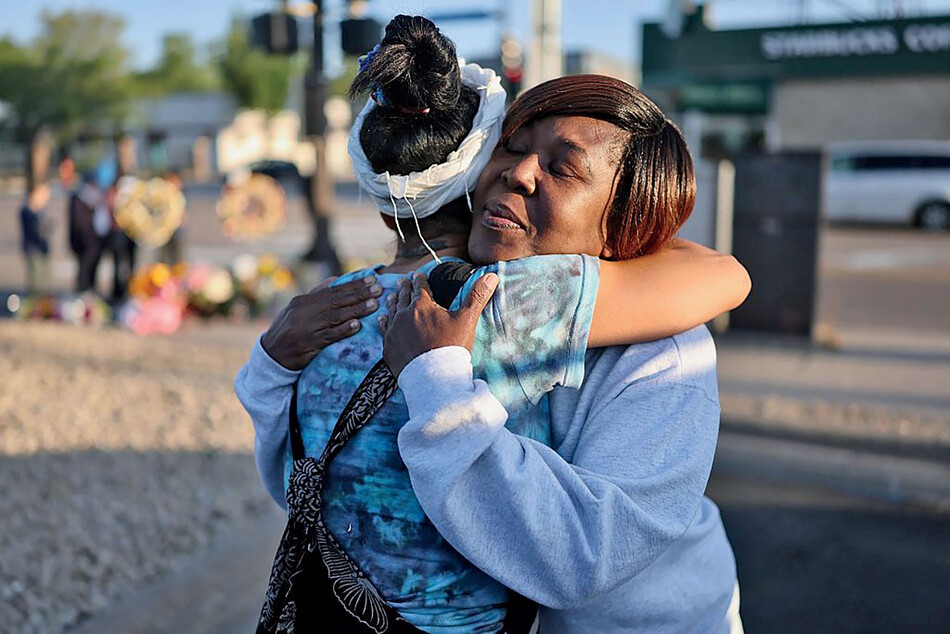
On a mild, sunny Wednesday morning last August, nearly two hundred children — kindergarteners through eighth graders — sat shoulder to shoulder in the pews of their Catholic school’s church in Minneapolis, listening to a recitation of Psalm 139: Search me, O God, and know my heart; try me and know my thoughts . . . Outside, a silver van pulled onto the campus. The driver, a twenty-three-year-old transgender woman and former student of the school, stepped out carrying an AR-15–style assault rifle, a shotgun, and a pistol. She walked briskly up to the church and, finding its doors locked, aimed her rifle at a stained-glass window. She pulled the trigger once, blowing the glass out in a burst of color. She then squeezed harder and didn’t stop, spraying bullets into the cathedral for nearly two minutes straight. When she was almost out of ammunition, she walked around the back of the building and shot herself, ending her own life. Inside, two children — an eight-year-old boy and a ten-year-old girl — were dead. Twenty-four other children, along with three adults, lay bleeding but still alive.
That evening, Minneapolis mayor Jacob Frey, a Democrat, delivered an impassioned speech in a nearby park, begging lawmakers to offer more than “thoughts and prayers” in response. “We are a city united in grief,” he said, his eyes welling with tears. “Let us take the next step, to be a city united in action . . . We need to have true gun reform, right now.”
A few days later, Minnesota governor Tim Walz jumped into the fray, announcing plans to convene a special legislative session on gun violence. He and other Democrats insisted that the negotiations would have to include a vote on banning assault weapons and high-capacity magazines — a condition that state Republican leaders rejected. With the two parties unable to agree even on an agenda, the talks collapsed before they began. In Washington, meanwhile, top Democrats and Republicans blamed each other for the nation’s gun-violence epidemic and offered no new solutions.
If state and national lawmakers couldn’t muster a response to the Minneapolis shooting, though, millions of parents, educators, and local officials across the country could. And in the ensuing weeks, they responded as Americans have in the wake of dozens of other high-profile school shootings this century: by fortifying their schools against would-be attackers. In rural districts and inner-city schools alike, in red states and blue, they drew up plans to install new automated gates, key-card access systems, surveillance cameras, motion sensors, magnetic door locks, metal detectors, bulletproof windows, and concrete bollards. They arranged for police officers to patrol their kids’ classrooms and hallways, conducted active-shooter drills with children as young as four and five, and in some cases encouraged teachers to carry firearms. A few states, including Pennsylvania, Michigan, and Virginia, approved millions of dollars in new funding for what education officials call “hardening” measures. (The military term, short for “target hardening,” has crept into parents’ and teachers’ everyday speech over the past decade.) Most others, including Minnesota, left it up to local communities to pay for security upgrades. This has forced districts to make difficult decisions about whether to invest in hardening measures or in counseling, mental-health services, and sports and music programs. Many teachers warn that shortchanging such programs will only make schools less safe in the long run, since the US is already experiencing a youth -mental-health crisis and many shooters are known to have histories of trauma and neglect. But their concerns are often overridden by parents’ demands for physical safeguards.
“It’s natural that when we see a horrible shooting on the news, we crave a response that feels as aggressive as the act itself.”
“Anytime a school shooting makes national headlines, the public conversation now centers on these types of hardening strategies,” says Sonali Rajan ’10TC, a professor of health promotion and education at Columbia’s Teachers College and an expert on gun-violence prevention. “Parents, understandably, want schools to do everything possible to protect their kids. And it’s natural that when we see a horrible shooting on the news, we crave a response that feels as aggressive as the act itself.”
Meeting this demand for quick and tangible solutions, and fueling it, is a sprawling school-safety industry. Today, dozens of US companies that originally catered to law-enforcement agencies and the armed forces now also woo superintendents with everything from bulletproof chalkboards to pepper-ball-spraying drones. According to market-research company IMARC Group, the industry is worth $3 billion and set to triple in size by 2033.
But are these tactics actually making schools safer? Or, as some critics assert, are they just causing kids unnecessary stress, disrupting their learning, and even exacerbating the risks they’re meant to address?
Rajan, along with Columbia epidemiology chair Charles Branas, has for the past several years been leading a pair of nationwide studies aimed at answering these questions. Supported by grants from the National Institutes of Health (NIH) and the Centers for Disease Control and Prevention (CDC), their studies together represent the largest, most scientifically rigorous investigation of school-hardening tactics ever conducted. By analyzing the security strategies of all 324 K–12 public schools that experienced a shooting in the US between 2015 and 2023, then comparing their policies at the time of the shootings to those of similar schools that had no gunfire, the researchers are evaluating the impact of dozens of common security measures on gun violence. They are also surveying children about their grades and mental health to see if aggressive security policies are having any unintended negative consequences. “Smaller studies have looked at the effects of individual tactics like arming teachers and the use of surveillance cameras,” says Branas, “but they haven’t assessed the collective impact of hardening measures or compared their effects in schools with and without shootings.”
Because no high-quality studies have ever examined the full range of school security practices, Branas says, parents and educators are working in the dark. “In the absence of good data, they’re pursuing strategies based on what feels right,” he says.
The scarcity of information about school security performance isn’t for a lack of interest among scholars. Until a few years ago, grants for studying gun violence in the US were almost impossible to come by, thanks to a little-known congressional provision that since 1996 discouraged federal agencies like the CDC and the NIH from funding any research whose results might be used to advocate for gun-control laws. “The rule was motivated by politics,” Branas says, “and disastrous in its consequences.” For decades, he says, little research on gun violence was conducted in the US. “As a result, we still have huge gaps in what we know.”
The federal blockade on gun research finally lifted in 2020. Over the next couple of years, the CDC and the NIH awarded more than thirty grants for academic studies aimed at understanding why gun violence happens and how to prevent it. Branas and Rajan, who had helped lead a nationwide push urging Congress to reverse the funding ban, were among the recipients. Of all the newly funded projects, their assessment of school security tactics may have the most pressing policy implications, touching the daily lives of some fifty-five million American youngsters.
“Everyone who works in schools knows that in order to create a safe environment, you need to invest both in physical security and in students’ mental well-being, since violent attacks can come from outside or within,” says Janet Robinson, who was the superintendent of schools in Newtown, Connecticut, at the time of the 2012 Sandy Hook shooting and is now a consultant on Branas and Rajan’s project. “But how do you find the right balance, when operating on a tight budget?” Currently, she says, school administrators don’t have the information necessary to make good decisions. “Meanwhile, you’ve got parents demanding that you take decisive actions and security firms selling you on technologies that would at least appear to make your schools safer.”
Later this year, the Columbia researchers will publish the first of several papers reporting their findings. The results, they say, may prompt a reassessment of how American schools try to protect kids.
“The takeaway is that these hardening strategies, when looked at cumulatively, seem to do little, if anything, to prevent shootings,” says Branas. “Which doesn’t mean that none of them have any value. But it does suggest that we ought to be looking at other options.”
Mass shootings of the type that now routinely make US headlines — in which a person kills a large number of strangers for no apparent reason — are a modern phenomenon, and a distinctly American one. Gun-wielding, grievance-fueled mass murderers first started mowing down crowds in schools, workplaces, restaurants, shops, and parks on a regular basis in this country in the late 1980s, initially striking a couple of times per year, on average. Such rampages have grown steadily more frequent since, with the United States experiencing twenty mass shootings last year alone, bringing the nation’s total over the past half century to more than five hundred, according to the Rockefeller Institute of Government. No other advanced democracy has experienced more than a handful of such incidents in that time. Mass shootings in the US have also grown deadlier over the years, as military-style weapons and large-capacity magazines have become more widely available. Studies show that these weapons enable shooters to harm more people by firing off dozens of rounds in rapid succession without stopping to reload.
Of the approximately forty-five thousand gun-related deaths that occur in the US each year — a body count that far exceeds those in peer nations — public mass shootings account for less than 2 percent of the total. (Suicides account for 60 percent of all US gun deaths, and homicides committed in the course of another crime, like a robbery, or between people in an argument, 35 percent.) Yet mass shootings have long played an outsized role in public discourse about firearms, according to Columbia terrorism and gun-violence expert Louis Klarevas. “The two types of events that have tended to push the needle on gun policy are mass shootings and high-profile assassinations,” says Klarevas, a research professor at Teachers College and the author of Rampage Nation: Securing America from Mass Shootings. “Mass shootings, in particular, burrow into our collective psyche because it’s easy for us to identify with the victims. We say to ourselves, ‘That could have been me in that supermarket, or in that park. That could have been my child in that school.’”
In Rampage Nation, Klarevas documents how in other nations, public outrage over mass shootings has pushed their lawmakers to enact gun regulations that have all but eliminated these events. Shortly after a forty-three-year-old man went on a shooting spree that killed sixteen children in the Scottish town of Dunblane in 1996, for example, the British government expanded an earlier ban on semiautomatic rifles to include most handguns, and the country has experienced only one shooting that’s killed more than five people since. Similarly, Australia imposed a ban on all semiautomatic weapons following a wave of mass shootings there in the 1990s; the nation didn’t endure another high-fatality rampage until this past winter, when two Islamic terrorists used a combination of rifles, shotguns, and homemade bombs to kill fifteen people at a Hanukkah event in Sydney. Within weeks, Australia intensified its already rigorous system of background checks and limited imports of firearms. Canada, Norway, Germany, and New Zealand have all enacted similar laws in recent years — and this, says Klarevas, has saved countless lives. Often, nations have responded to mass shootings by restricting access not just to assault weapons, but to broad categories of guns. “This ends up preventing suicides and homicides, as well as rampages,” he says.
There was a time when US lawmakers also took decisive steps to combat gun violence. In 1994, following a series of high-profile mass shootings — including one that saw five schoolchildren killed and thirty-one wounded in Stockton, California, and another in which twenty-five passengers on a Long Island commuter train were gunned down, ending in six deaths — Congress passed a federal assault-weapons ban. Eight years previously, the US had effectively outlawed civilian ownership of machine guns; the new legislation banned the sale of the closest substitute: semiautomatic assault weapons and large-capacity magazines. The measure was politically fragile from the start, though, with many Democrats in Southern and Western states joining Republicans in opposing it. To get the law passed, Democratic party leaders had to agree to a sunset provision that would see the ban expire in 2004, unless Congress renewed it. That renewal would never come.
In the 1994 midterm elections, Republicans campaigned heavily on gun rights and crushed the Democrats, taking control of both the House and the Senate for the first time in forty years. The Republicans then set their sights on academic researchers whose work they saw as laying the groundwork for additional gun regulations. These included emergency-room physicians who had begun chronicling the devastating injuries caused by semiautomatic weapons, as well as public-health researchers documenting links between gun ownership and risks of death and injury across populations. Some of these pioneering scientists, such as Emory University physician Arthur Kellermann and University of Washington pediatrician Fred Rivara, were publicly castigated by members of Congress, who accused them of political bias and called for their grants to be canceled.
“It was pretty shocking,” Rivara said in a 2013 interview. “Ten senators wrote a letter to the Secretary of Health and Human Services saying using federal dollars to lobby for gun control was unacceptable. We never did any lobbying. What they were really saying is that they didn’t want to see this type of research being conducted.”
The clash culminated in 1996 with the passage of the Dickey Amendment, a rider to a federal spending bill that stated that no CDC funds could be used to “advocate or promote gun control.” Named for Arkansas congressman and NRA ally Jay Dickey, the provision didn’t explicitly ban the government from sponsoring any research on gun violence, but administrators at the CDC and other agencies interpreted it that way, and federal funding for such research dried up. Young scholars were discouraged from entering the field, and many established researchers moved on to other topics. Consequently, by the early 2000s, the scientific community in the US was collecting much less information about gun violence than other public-health threats.
Gun enthusiasts, meanwhile, embarked on a historic buying spree. After the federal assault-weapons ban expired in 2004, sales of semiautomatic rifles and high-capacity magazines surged. Tens of millions of AR-15–style rifles flowed into civilian hands, even as annual sales of handguns, shotguns, and traditional rifles set new records.
As a result, scholars say, Americans now find themselves in a curious predicament: surrounded by some 400 million firearms — nearly half of the civilian-owned guns in the world — yet knowing startlingly little about who possesses them, how they’re being used, or how best to protect themselves and their families.

Despite the barriers erected by Congress, a small number of prominent researchers continued to study gun violence in the US, often relying on private donations or doing the work on their own time. Among this rarefied group — insiders say that in the leanest years of the Dickey Amendment, there were fewer than two dozen of them — is Charles Branas. A pioneer of “place-based” public-health interventions, which aim to enhance safety and well-being by improving the built environment, Branas is recognized for helping chart a path forward for gun researchers that circumvents the political blockade over gun control. His solutions — such as renovating vacant lots and abandoned buildings where young people might otherwise stash weapons — can seem modest, but studies have shown that they’re surprisingly effective, in part because people from across the political spectrum embrace them.
“My viewpoint is that all of us, regardless of our politics, can agree that we’ve got an urgent problem with gun violence in this country,” says Branas, an athletic fifty-eight-year-old with an intense but friendly demeanor. “We might have different ideas about what the ideal solutions are, but we can’t let that stop us from working together in the meantime. We can’t throw our hands up. We’ve got to get creative, find strategies that we all support, and get to work on them.”
Like many gun-violence researchers, Branas isn’t focused specifically on mass shootings. Those tragedies, he says, are the tip of the iceberg. “The deeper crisis is the hundreds of murders, suicides, and unintentional shootings that take place every day, out of public view,” he says. Branas notes that gunshots are now the leading cause of death for American children and teenagers, claiming thousands of kids’ lives each year — many of them in schoolyard and neighborhood shootings that never make national headlines. According to Branas, all forms of gun violence share underlying risk factors, such as poverty, social disenfranchisement, and unchecked access to firearms, so “interventions that address these root causes will have the biggest effect.”
Branas says that his worldview was shaped growing up outside Philadelphia in the 1980s, at a time when the city was reeling from deindustrialization, with cheap handguns and crack cocaine flowing into the city as fast as middle-class residents were moving out. “Shootings were a part of daily life, and I saw firsthand how they devastated families and entire neighborhoods,” he says. “It was a constant stream of suffering.” Determined to help, Branas took a job as an EMT after graduating from nearby Franklin & Marshall College in 1990. The work was relentless. “The ambulance I worked on would bring one gunshot victim to the hospital, and we’d race back out to get the next one,” he says. “There was never a break.” Emergency calls would come in from some blocks again and again. “I wanted to understand why that was,” he says. “I wanted to figure out how to stop these shootings in the first place.” He soon enrolled in an epidemiology course for paramedics and realized he’d found his calling.
The idea for one of Branas’s biggest breakthroughs would emerge years later from conversations with residents of Philadelphia. “My colleagues and I asked them what they thought could be done to stem gun violence, and they told us about the fear that surrounded a lot of abandoned properties, how teenagers would hide weapons in them and fights would break out,” he says. Some local nonprofits had begun to clean up such properties, but they weren’t sure what effect it was having. “So I said, ‘Let’s do something on a large scale, across the whole city, and test it scientifically.’ ” In a series of randomized trials, Branas and his team partnered with the nonprofits and the city to turn hundreds of vacant lots into parks. Private donors and federal agencies kicked in money to renovate dilapidated buildings, some of which were converted into affordable housing. The results astonished everyone: Gun-crime rates in the spruced-up areas dropped nearly 40 percent and stayed low for years. The strategy has since spread to New Orleans, Chicago, and other cities.
For all his emphasis on grassroots interventions, Branas is unequivocal that Americans’ easy access to guns is the main reason the nation experiences so much lethal violence. “Arguments that might otherwise have ended with a fist fight, result in people dying,” he says. “That’s a fundamental difference between the US and other countries.” Branas has not shied away from studying firearms directly. In a widely cited 2009 paper, his team found that people who are assaulted are more likely to be shot and killed if they are carrying a gun themselves — a discovery that challenged gun advocates’ long-standing claim that being armed is protective. The National Rifle Association pounced, publishing a critique in its flagship magazine, American Rifleman, that declared the study “junk science” and accused Branas of being in cahoots with activists trying to overturn “stand-your-ground” and “right-to-carry” laws. Branas found himself the target of an organized pressure campaign urging administrators at the University of Pennsylvania, where he was a professor at the time, to fire him. “That experience made me very thankful for tenure,” he says, noting that scientific reviews have since judged his study to be among the most rigorous ever on what scholars call defensive gun use.
In 2017, Branas was recruited to Columbia’s Mailman School of Public Health to lead its epidemiology department. Upon arriving, he met new allies in unexpected places across campus. Among them was Klarevas, who had used his own money to assemble one of the most comprehensive databases of mass shootings in the world and was mining it for clues about how to prevent them. There was Rajan, a child-health specialist who had begun documenting the psychological toll borne by children who witness gun violence or know someone who is shot, as well as the psychiatrist Paul Appelbaum ’72CC, the emergency physician Ashley Blanchard ’20PH, and the pediatrician Danielle Laraque-Arena. Soon a kind of salon took shape, with the professors meeting, exchanging ideas, and imagining ambitious new studies that blended epidemiology, education, psychiatry, and security studies. Out of those conversations grew the Columbia Scientific Union for the Reduction of Gun Violence, or SURGE, an interdisciplinary coalition that since 2020 has provided mentorship and networking opportunities for young scholars with novel ideas for tackling the nation’s gun--violence crisis but who are uncertain how to navigate the field’s precarious funding landscape.
“Because the field of gun-violence research was dormant for so long, young scientists had few senior colleagues to turn to for guidance,” says Branas. “We wanted to build up that infrastructure.”
Around the same time, fissures were starting to show in congressional support for the Dickey Amendment, with members of both parties expressing concerns about the lack of available information on shooting trends and prevention efforts. (Jay Dickey himself had publicly disavowed the provision before he died in 2017.) Branas and his Columbia colleagues joined forces with scientists across the US in pushing for a reinstatement of research funding, meeting with congressional staffers, briefing them on data gaps, and encouraging concerned parents and educators across the country to speak out. In an effort to demonstrate that the academic infrastructure existed to make good use of federal grants, they also worked with fellow gun researchers at the University of Michigan and RAND to lay the groundwork for what would become the first professional society in their field. (The Research Society for the Prevention of Firearm-Related Harms would launch two years later, with Rajan as its founding president.) “And it actually worked,” Branas says. “Reason prevailed and lawmakers agreed that we had to do more about this problem.”
Branas and Rajan then began developing plans for what would be one of the biggest projects of their careers: a long-overdue audit of the security revolution reshaping American schools.
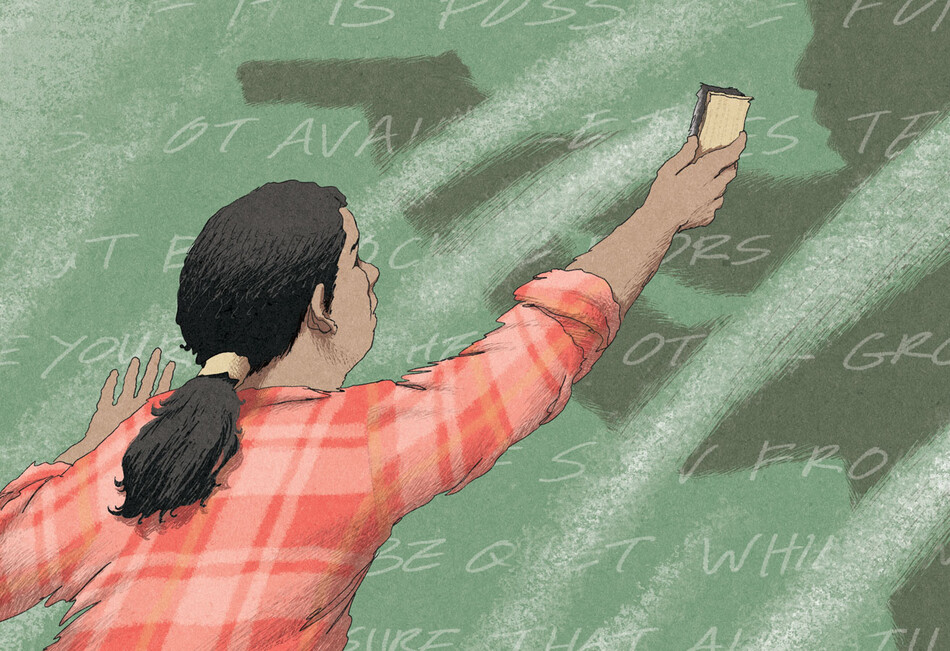
Each morning, millions of American children — from big-city schools in New York and Los Angeles to rural districts in West Virginia and Texas — begin their day by queuing up like they’re at an airport. They walk through metal detectors and past surveillance cameras, swipe their ID badges, and allow police officers to inspect their backpacks. In some schools, the officers may later enter classrooms to apprehend kids for infractions that once were handled with trips to the principal’s office. And every few weeks, these children will rehearse for the nightmare scenario: The lights will go out, and everyone will crouch behind desks or hide in bathrooms while adults carrying toy guns roam the halls, yelling and banging on doors, pretending to hunt for them.
“There’s a tremendous amount of variation between schools, in terms of which security measures get implemented, in part because there’s been little national guidance on the issue,” says Rajan, who early in her career ran youth-empowerment programs in New York City schools. “But there’s been an increase in hardening across the country, especially over the past decade.”
America’s experiment in school hardening began in the aftermath of the 1999 Columbine shooting, when two twelfth graders carrying semiautomatic handguns strolled into their high school without so much as a glance from a hall monitor and slaughtered thirteen of their fellow students and a teacher. Back then, few US schools, outside of some in high-crime urban districts, bothered even to lock doors or install surveillance cameras. “Now virtually all schools do these things and much more,” Rajan says. She points out that among the schools her team is studying, 90 percent regularly hold lockdown drills, most have law enforcement officers on campus, and about 2 percent arm teachers.
Advocates of school hardening say the more fortified a building looks, the less attractive it will be for someone intent on committing acts of violence.
But that’s not what the Columbia researchers have found. “Hardening a school may seem like it would prevent shootings, but it’s not at all clear yet that it’s accomplishing that,” says Branas.
In conducting their study, the Columbia researchers catalogued all the major security tactics employed by 648 schools — half of which had experienced shootings and half of which hadn’t — and matched the two groups of schools by demographics, size, and region in order to reliably isolate the effects of the security measures. In total, they examined twenty-seven common security measures to determine if any were associated with a school’s chances of experiencing a gun attack. They found that only a handful of the measures, notably the use of metal detectors, were linked to a reduction in risk.
“The benefits are so subtle that we’ll need to conduct follow-up studies to understand the impacts they’re having, and how schools might leverage them more effectively,” says Rajan. “Like, are metal detectors particularly useful in certain kinds of schools? Or only in combination with other measures?”
Surprisingly, the researchers found that the presence of police officers in schools is associated with an increase in the likelihood of a shooting. They say that follow-up studies will be needed to understand this finding, which shouldn’t necessarily be interpreted as evidence that police cause problems. One possible explanation, they say, is that school districts in regions with a strong gun culture might be more likely both to put officers in their schools and to have students with access to firearms at home, which is a known risk factor for youth gun violence. The researchers hope to soon gather more detailed information about how police officers are being deployed. “We wonder, for example, if the officers might be more valuable when they develop positive relationships with kids, acting as mentors, and only serve as disciplinarians when it’s absolutely necessary,” says Branas.
That beefed-up security doesn’t eliminate the risk of school shootings is unlikely to surprise many scholars who have studied patterns of gun violence. “It’s pretty clear that attackers don’t often choose targets based on how vulnerable they appear,” says Klarevas, who explores this question extensively in Rampage Nation and contributed to the new research. Instead, he says, mass shooters are typically motivated by grievances tied to particular places or groups of people, and will go after them regardless of a site’s defenses. Most other school shootings, he notes, stem from conflicts between students that erupt outside school buildings, where metal detectors and other security technologies offer little protection.
The Columbia study leaves some tricky questions unanswered. For example, gun-rights advocates have long argued that hardening tactics not only prevent shootings but limit casualties when they do occur. The researchers don’t evaluate the latter claim. “But other researchers could certainly do that,” says Branas, noting that his team’s database will eventually become publicly available. “Our research is meant to spark those kinds of inquiries.”
Currently, the Columbia team is analyzing their data to see if hardening tactics have any unintended consequences for students. For example, they’re examining whether the presence of police officers, metal detectors, and other security tactics are associated with higher rates of expulsions or student arrests. “Past research has suggested that overly aggressive security policies can lead to the criminalization of routine misbehaviors, especially for Black and brown students,” says Rajan. “We’re looking to see if our data bear that out.” The team is also investigating how hardening tactics may affect students’ mental health and academic performance. “A fundamental question is whether kids feel safer when schools are hardened, or whether being continuously reminded of the threat of gun violence stresses them out,” she says. The answer may have significant implications. One of Rajan’s most cited papers, from 2014, shows that teenagers who feel unsafe are more likely to begin carrying a firearm. “We don’t want to inadvertently fuel feelings of insecurity that could perpetuate cycles of violence,” she says.
None of this is to suggest, the researchers say, that schools ought not take common-sense measures to secure buildings, like controlling entry points, requiring visitors to sign in, and teaching kids what to do in emergencies. But what their new findings do indicate, they say, is that communities should think carefully about how much money they spend on hardening measures — especially if the goal is to prevent shootings. In fact, the researchers say there is a growing body of evidence that shows that investing in students themselves — through programs that support their social development, conflict-resolution skills, and mental health — may ultimately save more lives. “You really want to intervene and help young people before they ever pick up a gun in the first place,” says Rajan, who notes that the vast majority of school shooters are teenage boys. Yet, in the wake of school shootings, Rajan says, “people don’t want to hear about investing in after-school programs, opening more public libraries, renovating parks in surrounding neighborhoods, or hiring more school psychologists and social workers. There’s an almost forensic examination of the violent act itself, and an obsession with figuring out how we could have physically stopped it. But to prevent these killings, we really need to step back from that moment and pay more attention to the smaller, private tragedies that led up to it.”
The Columbia researchers say that their investigation is already giving them ideas for new types of anti-gun-violence initiatives. “We’re thinking up new ways of reaching out to students at the very end of the school day, because a lot of shootings occur right when classes are dismissed,” says Rajan. The team would eventually like to conduct a large, comprehensive assessment of how youth programs and social--support services influence rates of gun violence. “This would compare the impact of different types of programs offered by schools and local communities, similar to how we’re now analyzing the effects of hardening measures,” she says.
For now, the researchers are doing much of this work at night and on weekends. After last year’s federal spending cuts, which hit public-health initiatives especially hard, the vast majority of gun-violence-prevention projects funded by the CDC and the NIH were denied renewal. One of Branas and Rajan’s grants was among those shelved. So now the professors are pressing on with a smaller team, racing to complete the analyses they’d planned, and cautiously optimistic that the funding, and the attention the issue deserves, will one day return.
“We’re persevering and focusing on the work, as we’ve always done,” Branas says. “Our nation needs to understand this problem. It’s too big to ignore.”
This article appears in the Spring/Summer 2026 print edition of Columbia Magazine with the title "Schools Under Siege."