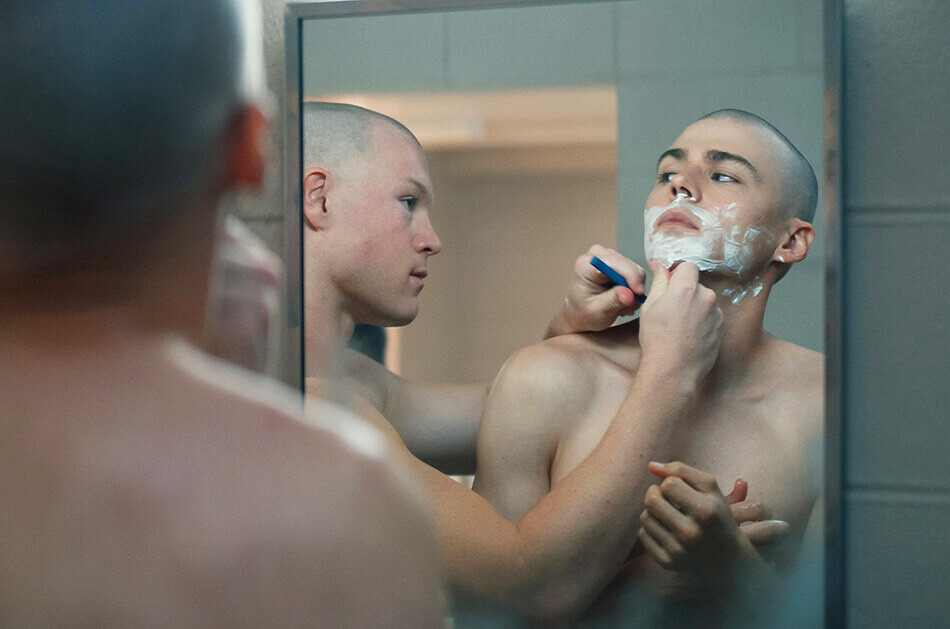
In the first episode of Boots, the popular Netflix dramady set in the early 1990s, Cameron Cope, a closeted gay teenager in New Orleans, meets with a Marine Corps recruiter with the hope of joining the military. He ends up enlisting and enduring a grueling thirteen weeks of bootcamp — all while trying to hide his secret. What most viewers might not realize is how close Andy Parker ’11SOA, the show’s creator and co-showrunner, came to having the same experience himself.
“I was a closeted gay kid in a conservative Evangelical home in Glendale, Arizona, and I was looking for my own way to deny or run away from the truth about myself,” says Parker. “I had a Marine recruiter come to my house and talk to my parents about why enlisting would be a good idea.”
In the end, Parker didn’t join the military — he went off to college at the University of Arizona, majoring in media arts — but the experience stuck with him. “I always wondered, what would my life have been like if I had done that? Would I have made it?”
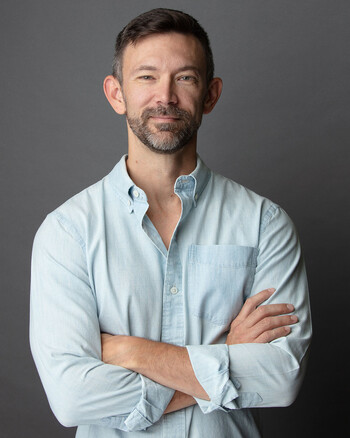
Parker will never have those answers, but he did eventually find success in another area: telling stories for TV. After graduating from college and working as an assistant to a metal sculptor in Tucson, Parker applied to graduate schools, hoping to break into screenwriting. “Somehow, they let me into Columbia,” he says. “I was really taken with the approach at the School of the Arts, which is so narrative-centric. They didn’t have all of the latest cameras and fancy gizmos like NYU, but they focused on the important thing, which was story.”
While at Columbia, Parker went through a profound personal transformation. “I finally came out, and as a result, I was able to find my voice as a writer,” he says. He also started to seriously pursue television writing at a time when prestige cable series like Mad Men and Breaking Bad were redefining the medium. “Nobody was interested in television when I first started at Columbia — everyone wanted to be Paul Thomas Anderson,” says Parker, who grew up religiously watching M*A*S*H reruns with his family. “But I looked around and saw that all of my favorite writing was on TV.”
Parker found a mentor in screenwriting professor Andy Bienen ’96SOA. “His approach to narrative has really stuck with me,” Parker says. Although there was no official television concentration at the school at the time, Parker started writing pilot episodes as part of his coursework. Professor Maureen Ryan ’92SOA, a veteran film and TV producer, approached him with the idea for a series set at US embassies in the Middle East, called Stanistan. Parker created the show on spec and wrote the pilot episode, and it ended up getting optioned and filmed — a rare feat for a debut screenwriter. Although the show wasn’t ultimately picked up, the achievement offered Parker a foot in the Hollywood door.
Over the years, Parker has served as a writer and producer on series like the dark comedy Imposters and the animated sci-fi drama Pantheon. But his biggest opportunity came in 2020, when he was approached to adapt The Pink Marine, the 2015 memoir by gay former Marine sergeant Greg Cope White, into a series. That project — the last produced by legendary television producer Norman Lear before he died in December 2023 — became Boots, with Parker serving as creator, co-showrunner, and executive producer.
For Parker, the experience was a full-circle moment. “It was basically ‘the road not taken’ for me,” says Parker. “I could see in myself the same motivations for why someone would want to join the military as a young gay person: searching for self-respect and assuredness, and feeling like the Marines are going to teach you to be a man. But in exchange, you have to give up an essential part of yourself. There was real dramatic tension there that seemed worth exploring.”
To drive the narrative and reach a wider audience, Parker and his producing team made a number of changes. While Cope’s book is set in the late 1970s when homosexuality was outright illegal in the military, Boots takes place under “Don’t Ask, Don’t Tell.” The first name of the protagonist, played by Miles Heizer, is changed to Cameron, and the series broadens its point of view to include other bootcamp trainees and officers, both queer and straight.
“We leaned into the universal coming-of-age story,” says Parker. “It’s not about one gay recruit and his struggles; it’s about every one of these guys becoming themselves. It approaches questions of what it means to be a man, about toxic masculinity, about identity and belonging.”
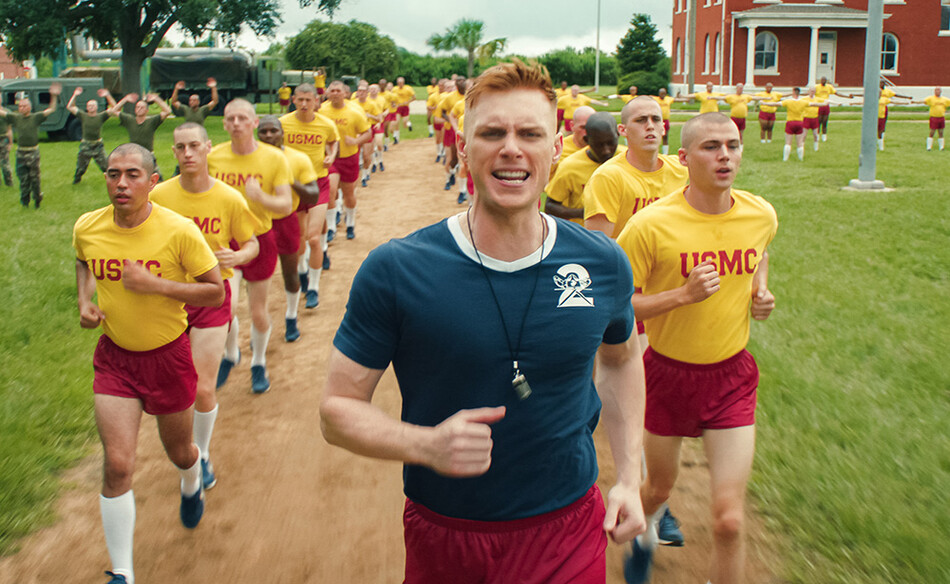
When Boots premiered in October 2025, the show soared to the top of Netflix’s most-watched list around the world and generated critical acclaim. It also invited heated discourse, with Department of Defense press secretary Kingsley Wilson deriding it as “woke garbage” — a statement that ultimately drove more attention and viewers to the show. “The series was never intended to be a polemic or a direct response to our political situation,” says Parker. “We didn’t know it was going to land in 2025 at a time when, for instance, trans people were being scapegoated and hounded out of the service unjustly.”
Parker acknowledges that Hollywood is more restrictive than it was when he entered over a decade ago at the dawn of the streaming era: tightened budgets have reduced the number of new films and scripted series, and the impacts of artificial intelligence on creative production are just starting to be felt. “There’s less appetite for risky ideas and niche programming now,” he says. Parker doesn’t take Boots’ existence, let alone its success, for granted. “One of the reasons I’m so grateful that Boots even got made is we have a queer lead in a mainstream show on the biggest streaming service in the world. I think that’s an increasingly difficult proposition.”
Although Boots was ultimately not renewed for a second season, Parker is optimistic about the show’s impact — and his own next steps. In January, the series received a nomination for outstanding new TV series from the GLAAD Media Awards, which honor depictions of LGBTQ+ figures in entertainment. And Parker has several other TV and feature-film projects in the works — “you always have to have other irons in the fire,” he says. He abides by the famous show-business mantra coined by Lear: “over and next.”