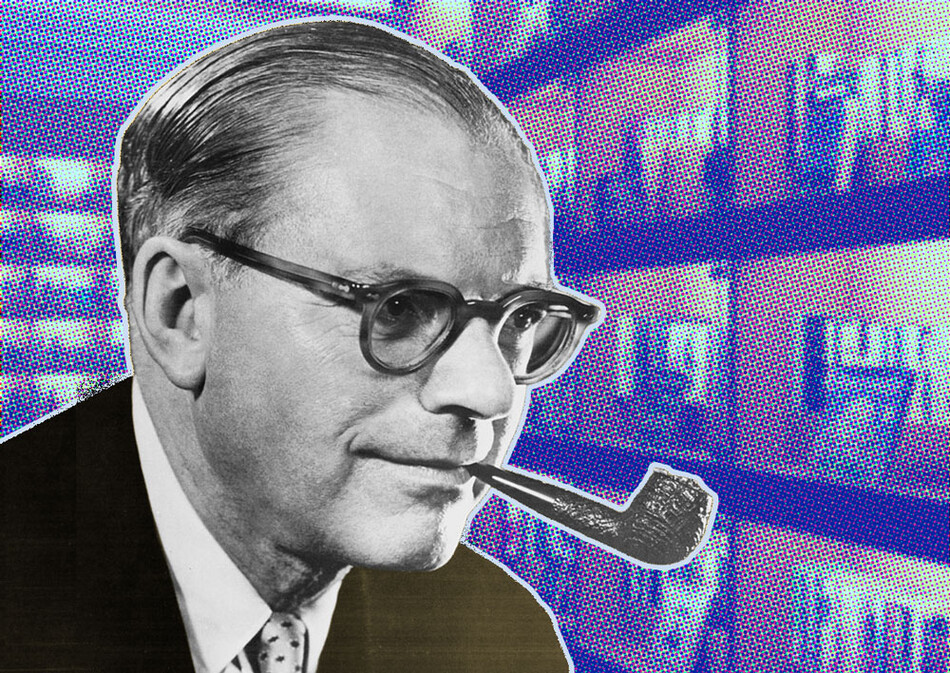
As the cofounder of Random House, Bennett Cerf 1920CC shaped the modern publishing industry and was instrumental in introducing America to writers like James Joyce, Truman Capote, Gertrude Stein, Dr. Seuss, Ayn Rand, William Faulkner, and many more. In her massive new biography, Nothing Random, Gayle Feldman, a former fellow at Columbia Journalism School, charts Cerf’s storied life and career.
Bennett Cerf’s influence on the literary world can’t be overstated. Why do you think he’s not a household name? And why has it taken until now for a comprehensive biography of him to be published?
There are several reasons. In his day, he had ephemeral renown because he was a regular on the game show What’s My Line? and was the author of several anthologies and columns. But it was also for those reasons that the intellectual establishment — especially people he didn’t publish — looked down on him as a lightweight. Profiles in The New Yorker and Esquire portrayed him as a jokester, not a serious figure, and many of the hundreds of people that I interviewed for the book confirmed this perception.
I was also told — though I can’t say how reliably — that his widow, who lived into her nineties, was difficult to get past. She was a gatekeeper, and earlier attempts at biographies stalled.
How did Columbia shape Cerf as a publisher?
Columbia was absolutely essential.
Bennett was a New York City public-school boy from Jewish Harlem who went to Townsend Harris, then the city’s only selective public high school. He completed two years but left before the third because his mother was dying of cancer. He worked in the garment trade until an uncle — only five years older and very influential — pushed him hard to attend Columbia.
He passed the entrance exam and entered a new world. He joined the Spectator, edited the Jester, read deeply, and reveled in literature. In his diaries he writes about reading Dante and the English poets — you can almost see his mind opening.
At Columbia, he also met people who shaped his life: Richard Simon 1920CC and Max Schuster 1917CC — the founders of Simon & Schuster — were fellow students, and Simon actually helped Bennett get his first publishing job. He knew Oscar Hammerstein 1916CC, ’54HON and Richard Rodgers ’54HON from this part of his early life. Columbia refined his natural gift for schmoozing and identifying influential people.
In your research, did you discover a divide between Cerf’s public and private selves?
Not a divide, really — more a continuum. He described himself as “a very unusual specimen.” He loved people, loved being known, and loved performing. That linked him to the theatrical and entertainment world.
For example, Frank Sinatra became a friend. Sinatra, a musical autodidact who did the New York Times crossword and studied the dictionary, admired Bennett. I interviewed Mia Farrow for the book, and she told me, “it was hard for Sinatra to look up to people, but he looked up to Bennett.”
Cerf’s battles over censorship — perhaps most famously his quest to get Ulysses published in America — helped reshape US literary culture. What did your research uncover about his motivations for taking on those fights?
He was deeply influenced by Horace Liveright, an extraordinary publisher who fought censorship and published early Hemingway, Faulkner, and Eliot. Bennett idolized him and learned both what to emulate and what to avoid (especially Liveright’s financial recklessness).
He was also part of a cohort of young, educated Jewish publishers — the founders of Knopf, Simon & Schuster, Viking, and others — who were democratizing the industry. Bennett knew that winning the Ulysses censorship case would put Random House on the map. He was shrewd and willing to gamble.
If Cerf were alive today, what do you think his priorities would be? What would he think about modern publishing?
He would be at the forefront of opposing book bans. In addition to the battle to publish Ulysses, he also fought censorship during the McCarthy era and published controversial works like Philip Roth’s Portnoy’s Complaint, which upset many Jewish readers.
He also anticipated the age of publishing conglomerates and proposed, long before anyone else, that Random House should acquire Penguin’s US operations, so the 2013 Penguin Random House merger would definitely be of interest to him. He would be deeply interested in AI and modern distribution dynamics.
Does anything of Cerf’s philosophy remain in Penguin Random House today?
Yes — the fight against censorship. Random House is leading that fight and putting resources behind it. We’re living in a closed era, and I see a direct line from both Bennett and his co-founder Donald Klopfer. Bennett was the outspoken maverick; Klopfer worked institutionally. Together, they built a legacy that persists.