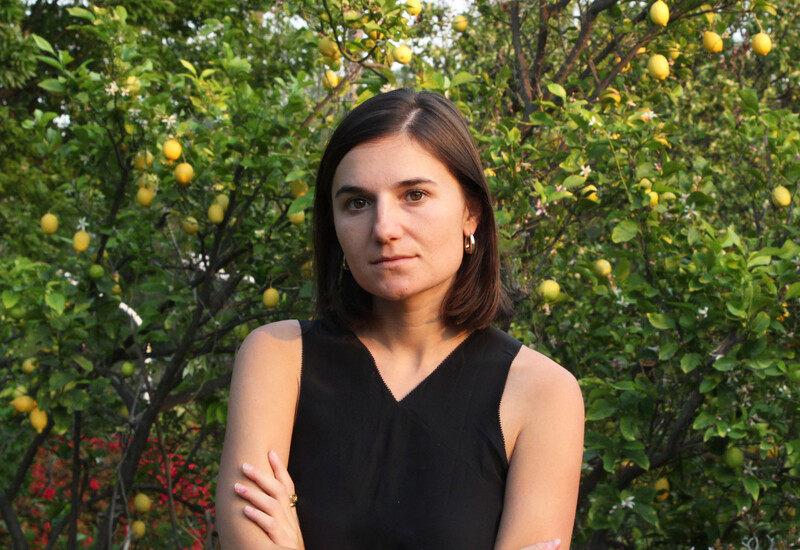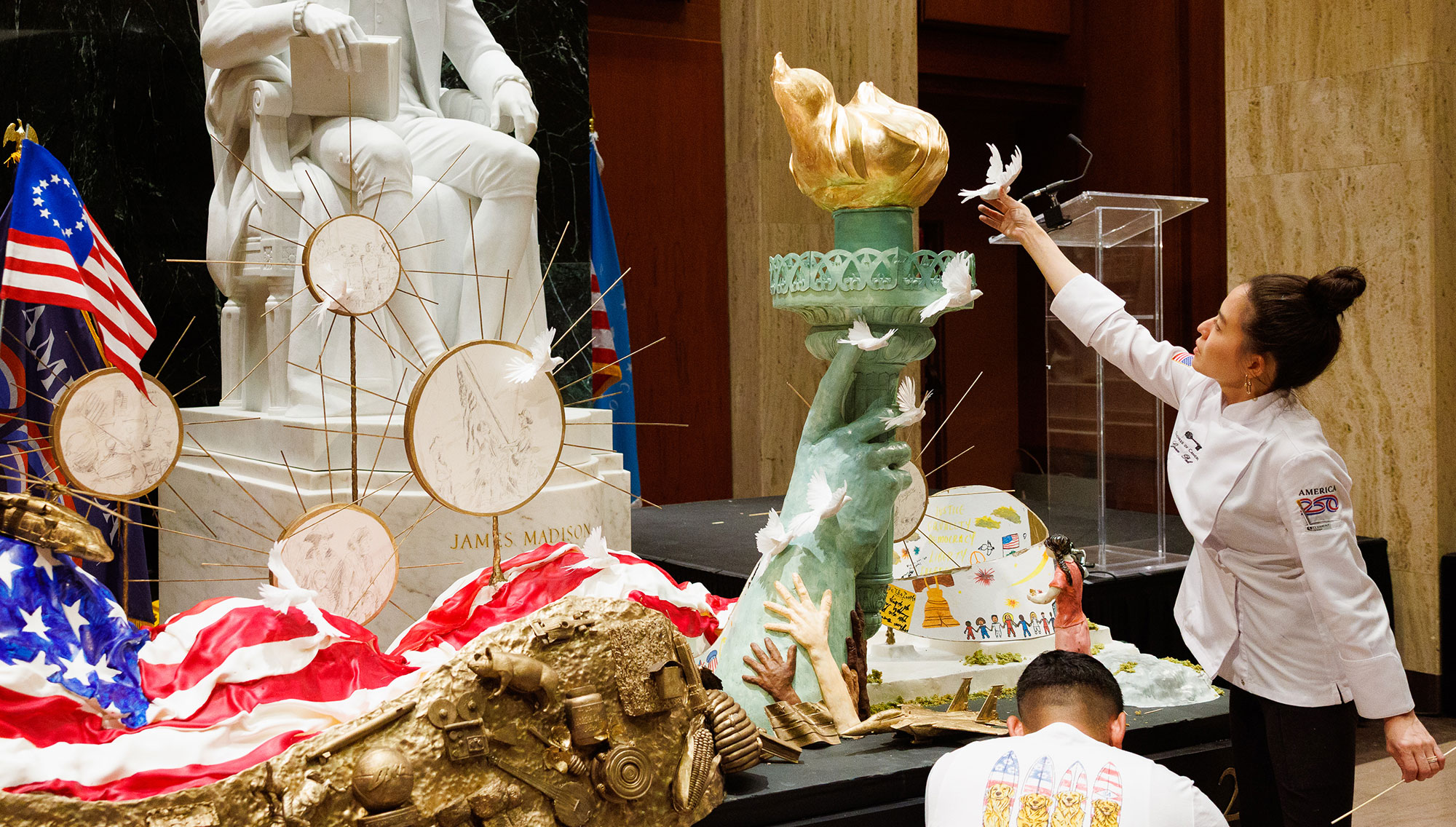
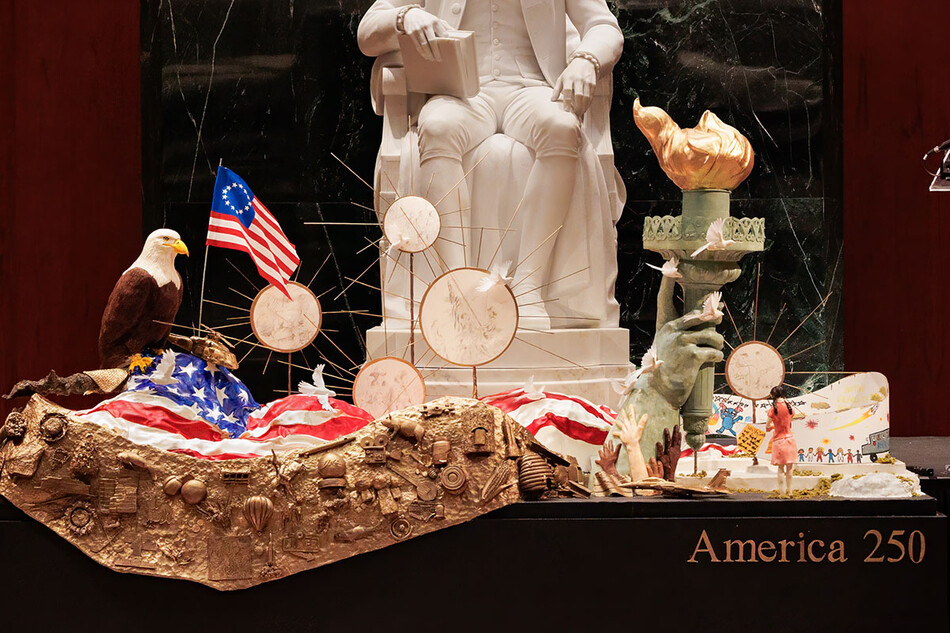
This past summer, when many Americans were winding down for a relaxing Fourth of July weekend, Grace Pak ’16TC was adding the final touches to the official America250 birthday cake: an edible sculpture of national symbols displayed at the Library of Congress and White House Visitor Center from July 4–August 2.
Pak, who studied neuroscience at Columbia before founding cake-art studio Duchess of Cameron, is accustomed to building elaborate desserts for weddings and other events. But this was no ordinary assignment. Pak created the cake pro bono to honor the nation’s anniversary in a bipartisan way, recruiting members of Congress from every US state and territory to help with the construction. “The politicians became instantly unguarded around the topic of cake,” says Pak, who has appeared on the Food Network and the baking series Is It Cake?
Pak’s Instagram is full of photos of her whimsical creations, and you can also find her work — a confectionery Butler Library — on the cover of the Fall 2026 issue.
How do you construct such elaborate cake sculptures?
Usually, I start by building a structure in my woodshop at home. Most people don’t realize that cakes on this scale are heavy and need a lot of support like wood and steel. Once the structure is made, I work in a commercial kitchen for all of the edible and baked portions. Everything you see on the outside is made from edible material like chocolate and sugar paste.
For a lot of the bigger cakes, we don’t serve the entire thing. It depends on the guest count and how long the cake will be displayed. For the America250 cake, which was on view for a month, we presented a portion for the cutting ceremony and stored extra servings for subsequent days.
How did you get involved with the America250 project?
I had previously worked with the Marine Corps on creating their 249th and 250th birthday cakes. Looking ahead to the 250th anniversary of the United States, I started wondering, who’s baking the cake for that? I reached out to the America250 Commission and quickly found out that there was no cake planned. So, I pitched the idea of creating one with bipartisan collaboration from members of the US House of Representatives and Senate, and the Commission loved the idea. The entire project was volunteer-based and all of the ingredients were donated.
How did the theme and design come to fruition?
I wanted all Americans to see themselves in the cake, but I quickly realized that it’s impossible to represent everyone, especially in a country like ours where people come from so many different backgrounds. Working with curators at the Smithsonian, I decided that I didn’t want to focus too much on the year 1776 — nobody celebrates the year they were born on their birthday; they celebrate their present life and what might be coming next.
I started to imagine, if I were to design a cake for a person called America, turning 250 years old, what would I portray? Eventually, I came up with the theme of “American Made.” Innovation has been a theme throughout American history — both for individual Americans and for the country as a whole. I wanted to celebrate those contributions, as well as acknowledge the mistakes made along the way.
How did you incorporate historic elements into the baked portion?
I went to the original gristmill at George Washington’s Mount Vernon, which continues to produce flour today. They milled whole-wheat flour just for the project. Fresh-milled wheat tastes very earthy, and I wanted to create a cake that brought out that flavor.
I studied recipes from the 1796 book American Cookery, by Amelia Simmons, which is the first known cookbook written by an American after the Revolution. In the 1700s, bakers used a lot of dried fruit soaked in heavy alcohol because there were no preservatives. Everything was whisked by hand. They didn’t have vanilla, so they used orange blossom water and rose water for flavor, and there were no chemical leaveners, so the cakes were very dense.
I came up with an original recipe that blended elements of historic and modern baking — the resulting cake was somewhere in between the light, fluffy cakes of today and the dense cakes of the eighteenth century. I incorporated ingredients such as butter from Vermont, currants soaked in Kentucky bourbon, corn flour as a nod to indigenous farming, thyme-infused honey and Granny Smith apples as nods to colonial agriculture, and imported spices like nutmeg and ginger that recall the trade networks from the time of the American Revolution.
How exactly did the congresspeople help with the cake?
It was a long process trying to get representatives from all fifty states and the territories signed onto the project. Everyone is so busy and scheduling was virtually impossible — up until a week or two before July 4, I was still scrambling to get people.
Every state and territory received a six-by-six-inch square of the cake to decorate. Since the theme was American Made, I asked each office, “What are the people of your state or territory making right now that you are particularly proud of?” People submitted ideas like sunflowers from Kansas and proa boats from Guam. I would sculpt the objects out of modeling chocolate and then bring the square to the representatives’ offices for them to add finishing touches, including painting with edible bronze. A lot of the politicians were really excited about the project, and a few said that it was the most fun they had ever had on Capitol Hill.