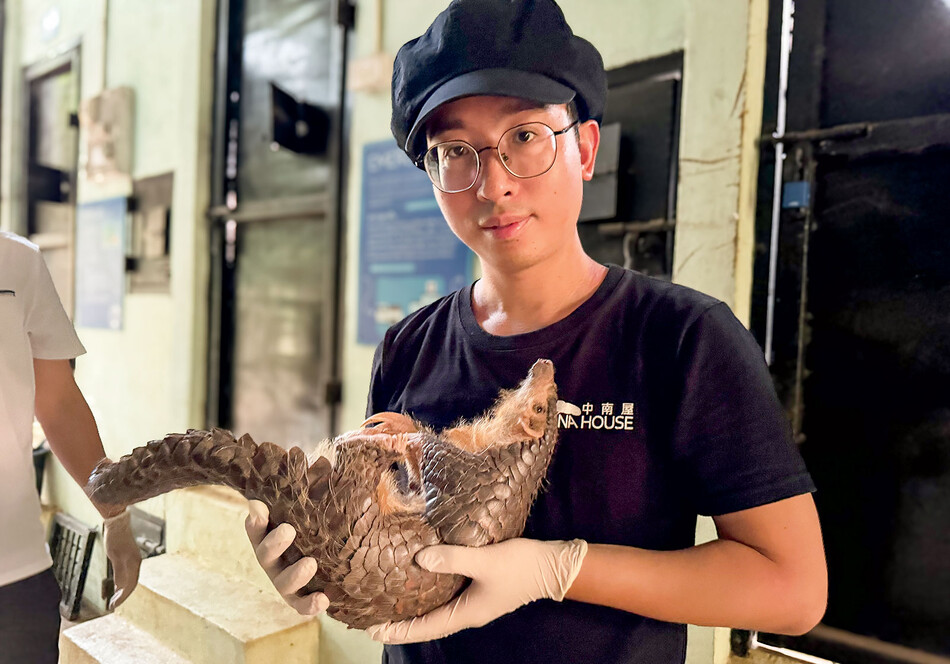
Rhino horn. Bear bile. Elephant ivory. Vendors in the bustling markets of the Laotian capital of Vientiane peddle many notoriously illegal wildlife products. They’re all unsettling to Hongxiang Huang ’13SIPA, but lately he’s been most focused on one critically endangered victim of the trade: the pangolin.
The scale-covered nocturnal mammals slurp up ants and termites with their long tongues. There are four species in Africa and four in Asia, with the Sunda and Chinese pangolins — both roughly the size of a house cat (excluding tail) — found in Laos. When afraid, a pangolin rolls into a ball. And, as the most trafficked wild mammal in the world, it has a lot to be afraid of. All pangolins are protected under national and international laws, but that hasn’t stopped poachers in places like Laos, where demand for its meat, as well as the powder ground from its scales, is still rampant.
The trade volume in Laos is “crazy,” says Huang, the founder and CEO of Agent C Wildlife Initiative, a nonprofit organization that sends Chinese people under cover to expose illegal wildlife trafficking. “I would estimate that about ten thousand pangolins are being sold and killed every year.” Watchdog organization TRAFFIC reports that between 2010 and 2015, 5,678 pangolins were confiscated in forty-three operations in Laos, with more animals seized in each subsequent operation in the same period. Nothing indicates that the crisis has gotten any better since.
In January, Huang spent ten days in Laos investigating the illegal pangolin trade with Agent C. On prior trips, the team had been in Laos chiefly to share intelligence with other interested organizations. This time, the members were taking action.
Going after the middlemen instead of the poachers, the group of volunteers staged sting operations to catch marketplace vendors trafficking pangolins and report them to authorities. The team also engaged in guerrilla tactics to shame consumers, mostly tourists from China. In one operation, the team papered Vientiane’s Chinatown with signs in Mandarin saying that people who eat pangolin must be impotent, referencing the widespread belief that consuming the animal boosts virility. “Most of the consumers for pangolin right now are male,” Huang says. The powder is also believed to cure an array of ailments, even though pangolin scales are simply keratin — the same substance that makes up human hair and nails.
Agent C broke new ground during that January expedition. Getting authorities in Laos to arrest anyone involved in the trade has been next to impossible, because law enforcement in the country is generally “quite bad,” Huang says. But he and his peers were pleasantly surprised when forestry officials confiscated four live pangolins after the group reported the vendors. The animals were delivered to a local rescue center and later released back into the wild. And under Laotian law, the vendors could, at least in theory, face hefty fines and up to five years in prison.
In China, media coverage of the operation — alongside the group’s informative, albeit graphic, social-media videos (one shows a pangolin being clubbed to death) — raised more awareness in his home country than Huang imagined was possible. “We’ve been getting millions of views,” he says, particularly on the Chinese messaging app WeChat. “You will see a lot of the comments from people who don’t realize that buying these kinds of wildlife products is illegal.”
Growing up in the southern Chinese province of Guangdong, Huang witnessed the ubiquitous roadside wildlife trade firsthand. “I had a dream of going to Africa to protect animals, because I read a lot about Dr. Jane Goodall,” he recalls. He ended up pursuing journalism, with the hope of investigating wildlife crimes. After he obtained an undergraduate degree from Shanghai’s Fudan University, Huang enrolled at Columbia’s School of International and Public Affairs for his master’s degree, looking to connect with professionals in the development world.
Following his graduation from Columbia in 2013, Huang got the opportunity to investigate southern Africa’s trade in ivory and rhino horns through a fellowship with Wits University, in Johannesburg. When visiting an illicit ivory market, Huang quickly realized that his physical appearance was key to rooting out traffickers: Vendors, he noticed, would hide their goods when white or Black people walked by, but upon seeing Huang, a more likely customer, they’d yell out Chinese words for “ivory” and “rhino horn.” The fellowship led Huang to found China House, a nonprofit focused on conservation and humanitarian work, followed by Agent C, and to team up with NGOs as an on-the-ground investigator. In 2016, his undercover work was featured in the Netflix documentary The Ivory Game.
Huang and his colleagues are planning another trip to Laos, where they’ve made valuable connections with local Chinese people who are eager to help blow the whistle on the pangolin black market. But given that tourism operators, sprawling souvenir shops, restaurants, and criminals with portfolios of illegal businesses all have a financial interest in the industry, the challenges are massive. Huang has even received death threats — and he knows that a hit in Laos costs just $8,000.
Is it all worth it? Huang thinks so, for a very simple reason: “I love animals.”
This article appears in the Spring/Summer 2026 print edition of Columbia Magazine with the title "Wildlife Warrior."