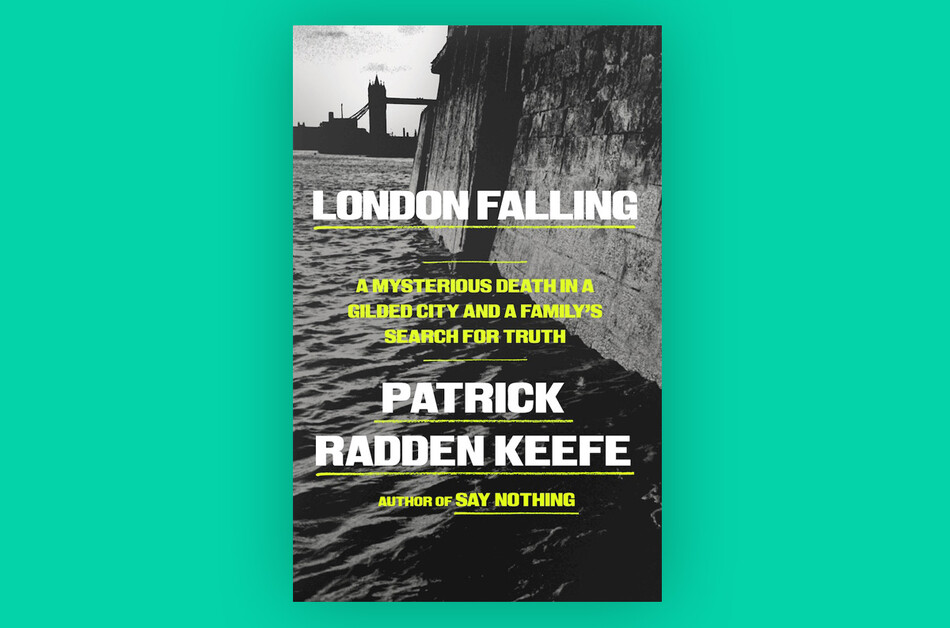
London Falling, the latest feat of impeccable reportage from Patrick Radden Keefe ’99CC (author of opioid exposé Empire of Pain and Say Nothing, about the Troubles in Northern Ireland), should come with a trigger warning to parents of adolescents. This book, which centers on the mostly thwarted efforts of a London couple, Rachelle and Matthew Brettler, to get to the bottom of how and why the body of their beloved nineteen-year-old son, Zac, washed up on a Thames riverbank on a chilly November morning in 2019, will activate every fear modern parents harbor about the minefields that await in a culture saturated with rampant consumerism, drugs, alcohol, weapons, and online toxicity of every imaginable stripe.
As its title indicates, this book focuses on twenty-first-century London, a milieu that, in Keefe’s rendering, makes present-day America look downright quaint. American readers who haven’t crossed the pond in the past couple of decades may be stunned to discover how radically the staid, stately city they remember has been transformed into a sleek, status-driven megalopolis where the skyline is dotted with newly built, mostly empty high-rises owned by impenetrable holding companies registered in other countries. The factors feeding this real-estate frenzy, which Keefe charts in a fascinating mini-history, include the decline of traditional British industries such as shipping and manufacturing, favorable residency policies for foreign nationals (particularly post-Soviet-era oligarchs fleeing Putin’s Russia) with millions of pounds to park in real estate and other easily disguised assets, and the UK’s notoriously lax enforcement of financial regulations.
Keefe’s portrait of London as a city “drunk on foreign lucre” serves as the backdrop for and, in the estimation of Rachelle and Matthew Brettler, a driving force behind their younger son’s shocking evolution from a lively, quick-witted boy to a reckless, wealth-obsessed impostor who plunges to his death from a riverside skyscraper. A turning point is Zac’s decision to transfer from the secondary school he attends as a day student to a posh, if not quite top-tier, boarding school favored by the children of Russian and Eastern European oligarchs. These scions’ casual extravagance and hyper-confident sense of entitlement — housemates who take Ubers to class on cold days rather than walk eight minutes, or who eschew the school uniform in favor of pricey designer suits — have a profound impact on Zac, whose parents are well-off but understated and unflashy in a traditional upper-class English way that he finds uninspiring. Long enamored of films featuring brashly ambitious young men, Zac becomes determined to act on his all-consuming desire to amass a fortune of his own.
Not long after graduation, as his parents discover only later, Zac begins introducing himself to new acquaintances as Zac Ismailov, the son of a Russian oligarch entrusted with finding investments for his family’s vast wealth. He soon falls in with a pair of unsavory denizens of London’s thriving underworld: a gangster named Verinder Sharma (aka Indian Dave) and a shady entrepreneur named Akbar Shamji, who take Zac under their wing and are instrumental in sealing his fate. They’re just two among Keefe’s large cast of vividly drawn crooks and con men.
Keefe unfolds the bulk of this story in classic true-crime fashion, much as Rachelle, a lifestyle journalist, and Matthew, a partner in a small banking concern, experience it: a bumpy road rife with blind alleys, dismaying revelations, and baffling contradictions. The Brettlers believe that their son’s death is the result of a crime. But they are confronted with a Metropolitan Police force that, hard hit by budget cuts, is indifferent to their quest for answers and incompetent in its feeble attempts to investigate. The two (with Keefe’s assist, after he learns about their case) are forced to become detectives themselves, tracking leads, questioning witnesses, creating spreadsheets of evidence, and poring over videos captured by hidden cameras. The official incompetence is so dumbfounding, particularly during key fact-finding opportunities, that Keefe speculates that the underlying cause is
police corruption.
Keefe, as usual, excels at weaving many tangled elements — historical and sociological analysis, family dynamics, underworld shenanigans, and hidden lives, including that of Rachelle’s late father, a famous British rabbi and public intellectual — into a spellbinding whole. Yet Keefe never loses sight of the beating heart and moral center that fuel this narrative: the quietly heroic, heartbreaking struggle of two grieving parents to make sense of the unthinkable.