
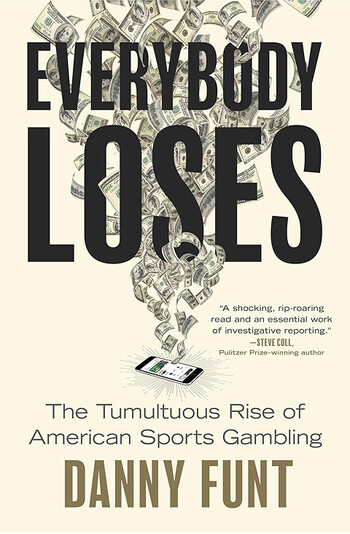
In his first book, Everybody Loses, journalist Danny Funt ’15JRN explores the astronomical rise of a high-risk vice.
How did you become interested in sports gambling?
The first piece I ever wrote about sports betting was for Columbia Journalism Review. I was interested in how gambling fit into the relationship between sports and the media. For example, reporters now have access to locker rooms and coaches, giving them insider information that would be incredibly useful to gamblers. That piece made me interested in the complex issue of sports betting as a whole.
What shocked you the most?
I think the whole VIP side of the business. The major sports betting sites like FanDuel and DraftKings have these robust perks programs to keep their “VIPs” betting at truly phenomenal rates. As a sports fan, I didn’t think it was possible for money to buy the kind of perks that these companies are using, things like throwing out the first pitch at a Major League Baseball game. The programs are designed to make these customers feel special and important. But in reality, it’s because they’re the losers — they’re being rewarded for betting consistently without winning significant amounts. There’s so much that’s delusional about gambling, and this is maybe at the top of the list.

And at the same time these companies are incentivizing losing streaks, they make it impossible to have a winning streak, by continually adjusting the amounts customers can wager after they win.
Right. Sports books are able to profile customers very quickly, and cut off anyone who has an edge. In the book I tell the story of an attorney named Beau Wagner, who had a hunch about Knicks role player Evan Fournier, who tended to perform well against his former team, the Boston Celtics. Wagner placed a $50,000 wager that Fournier would end up the high scorer in a game against the Celtics, and he was right. This is the kind of story that DraftKings likes to promote, because it makes people think they can win big. The company tweeted out Wagner’s winning ticket with the caption “Beau Knows Betting.” But the next day, Wagner realized that DraftKings had limited his account. He could no longer bet more than $100 on an NBA game, and not more than $3.63 on a player’s single-game shooting. You can make a reasonable argument that these companies need to restrict certain people’s wagering, or they’d go out of business. But the way that they’re doing it is galling.
Is it possible to be successful at sports betting?
Some people do make a living as professional sports gamblers, but it’s a grind. It’s very hard to win at the sports that people like to bet on, like football or basketball — you have to pick more obscure wagers. And even if you do manage to win, most of your time is spent on deceptive methods to keep sports books from identifying you and limiting your ability to place bets. Most successful gamblers use “beard accounts,” where they partner with other people who actually place the bet, for a cut of the winnings.
Sports leagues were once staunchly opposed to gambling, but they’re now an integral part. How did that evolve?
Until very recently — basically until 2014, when NBA commissioner Adam Silver published an op-ed in The New York Times in support of legalizing gambling — it was seen as an evil that could destroy sports. But of course it all comes down to money. The gambling industry commissioned more than $1 million worth of studies from Nielsen, the company that measures TV audiences. It found that gamblers watch far more sports than regular fans and that they watch until the end of the game. Nielsen found that every year, the NFL would make almost $2.5 billion more if sports betting was made legal. So, despite decades of opposition, the money was just too good to pass up.
You start the book with a harrowing story about a college basketball player who has the game of a lifetime, only to be the subject of online abuse because his winning basket impacted the points spread. How do you think gambling affects the actual players?
It’s escalated beyond the point of harassment. Some players are regularly getting death threats, and I think it’s only a matter of time before something truly catastrophic happens. The recent scandal involving college basketball players participating in a points-shaving scheme also highlights the pressure that some of these athletes are under. For the most part, I think athletes don’t want to be involved in gambling, but the temptation is clear.