Academic purges, investigations, harassment, arrests of journalists: If history, as Mark Twain is credited as saying, doesn’t repeat itself but often rhymes, Mother Goose herself might blush at the consonance of today’s “enemy of the state” rhetoric and the 1950s, when Senator Joe McCarthy demagogued Americans into an anti-communist fury.
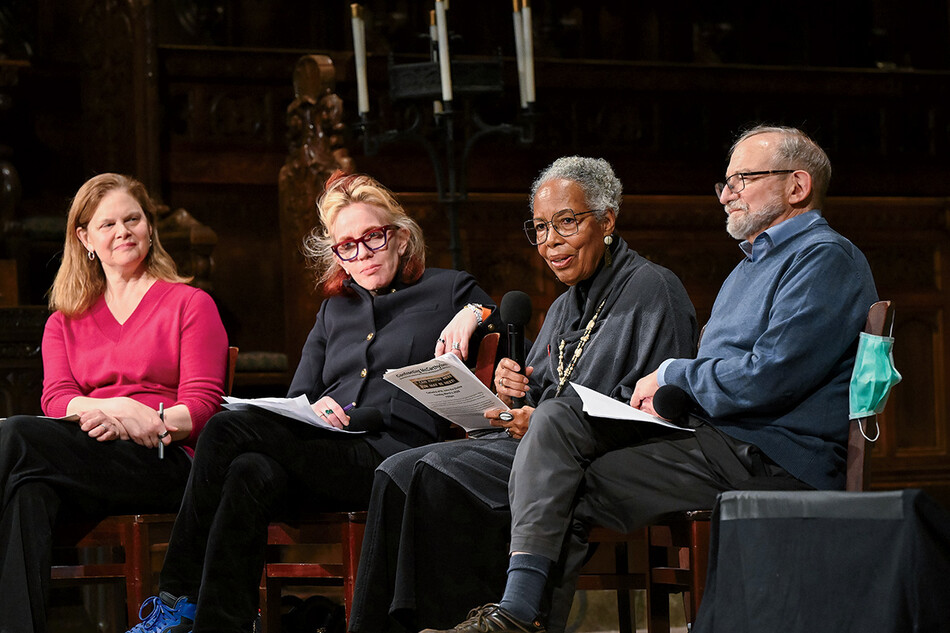
In that light, a recent talk called “Confronting McCarthyism,” cohosted by Columbia University Libraries, the Lehman Center for American History, and the Cathedral of St. John the Divine, brought together three descendants of American Communists: Molly Jong-Fast ’97BC, granddaughter of novelist Howard Fast, imprisoned in 1950 for refusing to name donors to a home for orphans of the Spanish Civil War; MaryLouise Patterson, daughter of William and Louise Patterson, prominent Black labor organizers and civil-rights activists; and Michael Meeropol, son of Julius and Ethel Rosenberg, executed in 1953 for espionage. The trio shared family stories and condemned today’s state-sponsored left-baiting — what Patterson called “a third Red Scare.”
Historian Beverly Gage ’04GSAS moderated the talk. Although the topic was McCarthyism, she noted that the speakers’ kin also were investigated by the FBI and the House Un-American Activities Committee (HUAC), of which McCarthy was not a part, and prosecuted by the courts. “If we de-center Joe McCarthy,” Gage said, “we see a much longer and much more continuous story.”
Meeropol, a retired professor of economics, explained that after World War II, the United States had a choice: to “continue on the path toward social democracy that began with the New Deal and the acceptance of the Soviet Union as a partner in the world,” or to reenact the Red Scare that followed the Russian Revolution of 1917. It chose the latter, he said, leading inexorably to the Cold War — and to a crusade to vilify those who opposed it.
“We knew not to talk to strangers,” said Patterson, who, like Meeropol, grew up in the 1940s and ’50s. “Not because they’d kidnap us, but because they might be FBI agents.” Patterson portrayed World War II as a global struggle against “the attempted takeover of fascists,” in which “African Americans valiantly fought” to defeat European fascism and, by extension, the American fascism of Jim Crow. But the US government “wasn’t about to liberate the twenty million African Americans.” Indeed, said Patterson, who is a retired pediatrician, anti-communism was “mostly a pretext” to stop labor movements and Black liberation.
Jong-Fast, a journalist and author, told of being confused as a child by stories of the anti-communist witch hunts. Why had her grandfather, who never committed a crime, been jailed for three months? Her mother, the writer Erica Jong ’63BC, ’65GSAS, explained to her that “you might find yourself in a country that no longer recognizes its own rules.” Jong-Fast then read a passage from Howard Fast’s autobiography, regarding his FBI files: “The lousy bits and pieces of my life are nowhere in those pages, only the decent and positive acts: speaking at meetings for housing, for trade unionism, for better government, for liberalism, for a free press, for the right to assemble for higher minimum wage, for equal justice for Black and white, against lynching and against the creation of an underclass, against injustices, wherever injustice was found, and for peace.”
Patterson, who said she learned about Reconstruction from Fast’s 1944 novel Freedom Road, spoke of how her father and Paul Robeson 1923LAW each presented a petition to the United Nations in 1951, charging the US government, in its treatment of Black Americans, with violating the 1948 Genocide Convention. The US Department of State retaliated by illegally revoking Patterson’s passport, as it had done earlier to Robeson. “They were hauled into court and before the HUAC,” Patterson said. “And I believe in the end, it cost Paul Robeson” — who suffered repeated mental-health breakdowns in the following decade — “his life.”
The death of the Rosenbergs was more succinct. On June 19, 1953, Julius and Ethel (Julius went first) were strapped into the electric chair at Sing Sing. Meeropol doesn’t deny that his father, convicted of conspiracy to pass atomic secrets to the Soviets, was a spy, but he suggested that the execution had a political purpose: “One of the most significant impacts is it frightened the hell out of many leftists.” To justify the death penalty, Meeropol said, the government “had to promote my father to a master atomic spy, which we know is not true. Then, to further pressure my father, they arrested my mother, when they knew she wasn’t a spy.”
Meeropol acknowledged that “terrible things” occurred under Stalin, and that US Communist leaders erred in backing the Soviets at every turn. And Patterson argued that the USSR, under pressure from the Cold War for much of its seventy years, hardly had opportunity to fulfill the principles on which it was founded — many of which, she observed, “are in sync with the values of this institution that we’re sitting in.”
Gage then asked if the pro-communist Americans under discussion thought of themselves as patriots.
“They loved this country,” Patterson answered, and cited Robeson’s 1956 HUAC testimony. When a congressman asked Robeson why he didn’t stay in Russia, which he had visited and found free of racism, Robeson replied, “My father was a slave, and my people died to build this country, and I am going to stay here and have a part of it, just like you.”