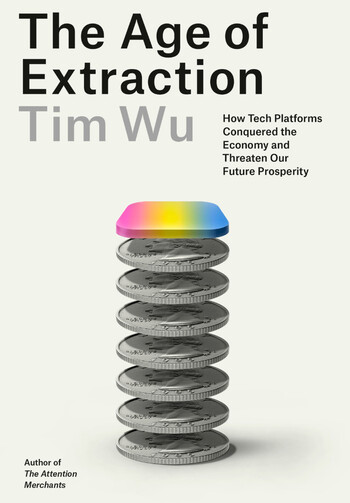
The concept of “wealth extraction” is at the heart of your book. What do you mean by that?
“Extraction” refers to the ability to capture wealth and other valuable assets like data, attention, and time. Essentially, it means having the power to extract more money and value than people would otherwise be willing to pay in a competitive market.
And can that happen without someone knowing?
It depends. Sometimes you’re aware when you’re paying more than you want to — like for an airline ticket or rent — but you still do it. That’s the visceral feeling of extraction: “I don’t want to pay ten dollars for bottled water, but I guess I will.” It’s a kind of coercive taking, though it’s not robbery. It’s different from someone pointing a gun at you but also different from paying a fair market price. One phrase I use in the book is “the extraction imperative”: the sense that business leaders see it as their job to use whatever power they have to get as much money as possible out of people.

You describe how tech companies have built “convenience cocoons” in which everything we do happens inside their ecosystems. Can you explain that, and do you think there’s any real way for people to step outside of these cocoons?
The ideal business model for a company now is to create a space where almost everything a consumer wants is available so that person never has to leave. Amazon is perhaps the clearest example of this. Of course, it’s not impossible to leave Amazon’s cocoon and to buy things elsewhere, but the small frictions — like typing in credit-card numbers or creating new accounts — make a huge difference.
This model isn’t fully coercive; it’s not forcing you to stay. But the careful cultivation of monopoly power tends to keep us inside the system once we’re in.
You write about the danger of emotional reliance on AI — how we might start forming personal relationships with technology. That’s already starting to happen. Are companies crossing an ethical line by allowing it to happen?
As I mentioned, the key to the cocoon business model is convincing people not to leave. And emotional attachment is a powerful tool for that. It’s already happening, and it’s a natural evolution: as platforms mature, manipulating emotional attachment becomes an obvious business strategy.
Is it ethical? No, it’s not. It’s manipulative. There’s something dark about designing AI to become a friend or lover for the purpose of extracting money or data. It’s not as overt as a scam, but it’s a softer version of emotional exploitation.
As for what can be done? Well, it’s uncharted legal territory. We might eventually need laws against emotional manipulation by AI. For now, it’s mostly a philosophical and ethical challenge.
You draw parallels between today’s tech giants and economic systems through history, like feudalism or fascism. What would it actually take to rebalance that kind of power today? Is there a digital-age version of the New Deal that could work?
First off, it’s important to understand that feudalism isn’t just ancient history. It’s always possible to slip back toward it. The existence of a middle class isn’t guaranteed. It’s easy to imagine a system where a small elite controls most wealth while everyone else struggles to move upward.
A digital New Deal could help rebalance things. We’ve faced moments like this before, like when railroads or trusts became too powerful. Those eras led to reforms, antitrust action, and the New Deal itself.
We may be in another such moment now, and dissatisfaction is growing across the political spectrum. The danger is real, but so is the opportunity for reform.
You end the book by talking about fairness and the idea that in the future we might be able to create a world that is less unequal than it is today. What gives you hope that we can move toward something less sinister?
One thing that gives me hope is that the public is fed up. Economic dissatisfaction is widespread. History shows that concentrated power eventually provokes a reaction — the American Revolution, the Progressive Era, the New Deal. There’s a recurring cycle where people push back against excessive economic power.
I believe people still want a society with a strong middle class and fair opportunity. We’ve built that before, and we can again.
This article appears in the Winter 2025-26 print edition of Columbia Magazine with the title "Escaping the Convenience Cocoon."