For as long as she can remember, Lauren Citro has wanted to be a mother. “One of my earliest memories is of running around my yard when an older relative asked me what I wanted to be when I grew up,” she recalls. “And I shouted, ‘I’m going to be a mom!’”
Her dream seemed to be taking shape in 2010, when during her last semester of nursing school, Lauren met Andrew, a young technology consultant who shared her love of children and family, in her hometown of St. Louis. “We talked about kids on one of our first dates,” says Citro, who is now thirty-eight. “The desire to be parents was a big part of our bond.”
The couple married in 2011 and set about planning a family with the same optimistic sense of purpose that had brought them professional and personal success. They rented an apartment with an extra bedroom suitable for a child and strategized about exactly when to conceive — autumn, they agreed, to ensure a summer birthday. “At first, we used contraception, to give ourselves time to get ready,” Lauren remembers. “And then, right before our second anniversary, we decided, ‘OK, we’re ready to do this. Let’s make our family now.’”
The Citros expected to be celebrating within weeks. But the positive pregnancy test never came. “I knew on a rational level that even young, healthy people don’t always get pregnant right away, but it was still an emotional blow,” Lauren says. “I’d always assumed that I’d get pregnant when I was ready.”
After almost a year of trying to conceive, Lauren spoke to her primary-care physician, who prescribed her Clomid, a drug that stimulates the ovaries to release more eggs than usual each month. When this didn’t lead to pregnancy, Lauren started seeing fertility specialists. They recommended intrauterine insemination, or IUI, one common type of artificial insemination, in which sperm is inserted directly into the womb. When that too failed, the Citros moved on to in vitro fertilization, or IVF. The most powerful fertility treatment available, IVF involves surgically removing eggs from a woman’s ovary, placing them in a petri dish with eager sperm, incubating the resulting embryo for a few days in the laboratory, and then implanting it into the uterus. It is expensive, time-consuming, and physically grueling. Women endure weeks of hormone injections that cause bloating and mood swings, followed by invasive egg-retrieval procedures that may leave their bodies bruised and sore. Yet IVF is also highly effective, with healthy women under the age of thirty-five typically succeeding in having a baby within a few tries. Lauren’s case proved unusually challenging, though. Doctors struggled to find mature eggs in her ovaries, to coax those eggs to become healthy embryos, and to get those embryos to implant properly in her womb. She finally became pregnant through IVF in 2016 but miscarried within a few weeks. The next year, the same thing happened.
“When IVF didn’t work for me, it was a whole different level of heartbreak and confusion,” she says. “I started to feel like I had no control over my body, over my life.”
Lauren and Andrew were hardly ready to give up, though. Like so many couples who experience multiple miscarriages, they only became more determined, moving from clinic to clinic, drawn by promises of better odds. Over the next several years, they visited four different fertility centers on the West Coast, where they’d relocated for work, spending more than $100,000 on IVF-related procedures. All of them ended in disappointment. Along the way, doctors ran tests for the most common causes of implantation failures and miscarriages — hormonal imbalances, immunological issues, genetic abnormalities — but found nothing unusual. “Everyone reassured us there was nothing to worry about and that we’d get there eventually if we just kept trying,” Lauren says. “They said it was a numbers game and that persistence would pay off.”
By 2021, after a third miscarriage, Lauren was physically and emotionally drained. “The grief I went through every time was unbelievable,” she says. “We lost all of our pregnancies early, but they were still babies to me.” Her pain was intensified, she says, by a fear that she was somehow to blame. “I’d heard that miscarriages could be triggered by psychological stress and all sorts of other factors, from gluten to processed foods to too much exercise to not enough. And I realized that I’d eaten fried food on the day of my last miscarriage. So for a while I was convinced that’s what did it.”
Then one evening, curled up on her couch with a cup of tea, Lauren opened her laptop and clicked on a series of informational videos recommended by a nursing colleague who knew what she was going through. On the screen appeared Zev Williams, a reproductive endocrinologist who directs the Columbia University Fertility Center (CUFC). He discussed his team’s research on recurrent miscarriages, a problem that he said affected tens of thousands of couples in the US every year but had long been overlooked by the medical establishment. Williams explained that while doctors only identified the cause in a fraction of such cases, many more could be diagnosed and even prevented. A woman’s own behavior, he emphasized, was almost never to blame. “It was the first time I’d heard that miscarriages like mine weren’t just bad luck or something you could fix yourself,” Lauren remembers.
The next day, she reached out to Williams’s office at Columbia and scheduled a telehealth appointment with him, thinking of it as a last-ditch effort to find answers before giving up on fertility treatments for good. A few weeks later, she found herself speaking with Williams over Zoom and engaging in the longest, most thorough medical consultation she had received in her eight years of treatment. Williams spent more than an hour asking open-ended questions about every aspect of her health history — her energy levels, digestion, menstrual cycles, weight fluctuations, even childhood illnesses. “He asked me different questions than other doctors,” she says. “It was more about my whole-body health rather than just my reproductive system.”
Drawing on that conversation and his encyclopedic knowledge of risk factors for miscarriage, Williams ordered a battery of tests that no other physicians had thought to run. Among them was a blood test to measure insulin levels and a uterine biopsy to check for a particular type of viral infection. “Sure enough, the results came back showing that my insulin was high — which nobody would have guessed, since I’m pretty small,” Lauren recalls. She also harbored a long-dormant infection in her womb. Both were treatable with cheap, safe medications that Williams prescribed. Lauren completed several courses of treatment under the oversight of Columbia nurses and then, in December of 2021, underwent a new embryo transfer at a clinic in California.
Soon after, they saw a plus sign on a pregnancy test. “Of course, we’d been there before,” Lauren says. But the next month, during an ultrasound examination, she witnessed something new: images of a small dark sac forming in her belly, and within it a pea-sized embryo just beginning to pulse with electrical activity. A few weeks later, a tiny body appeared, its spine curled in on itself, with delicate arms and legs starting to bud. “I talked to my baby in bed after that,” Lauren says. “I’d say, ‘I’ll take care of you, I promise. My body is a safe place. Please stay with us this time.’”
Today about 15 percent of American couples who are trying to conceive will be unable to do so after a year. Another few percent will get pregnant but endure repeated miscarriages. The causes of such reproductive challenges, scientists say, are split about evenly between male and female factors. Some couples will find an easy solution, perhaps learning to time intercourse around ovulation or to cut back on alcohol, drugs, or smoking. Others will manage to get pregnant after receiving treatment for underlying conditions like endometriosis or blockages of the reproductive tract. Women with autoimmune conditions — which can cause the body to mistake a fetus for a foreign invader — are often able to carry a baby to term with the help of immuno-suppressant drugs. In fact, most people who find it difficult to have children will ultimately succeed without the help of “assisted reproductive technologies” like artificial insemination or IVF. But for those who continue to struggle, IVF is a powerful last resort, now accounting for nearly 3 percent of all US births, or about a hundred thousand each year.
“In vitro fertilization is one of the great triumphs of modern medicine,” says Williams, seated in his office on a crisp fall day at CUFC. “It’s given millions of people who wouldn’t otherwise be able to have biological children the chance to do so.”
Indeed, since IVF first became widely available in the 1980s, it has evolved from a niche procedure intended mainly for women with uterine malformations into a versatile tool for addressing many forms of infertility. Used in conjunction with other advanced technologies, IVF can now help people with poor egg quality, low sperm count, and dangerous genetic mutations to have kids. Combined with egg freezing or donor eggs, it can effectively extend women’s fertility window by several years. The procedure has also become affordable to more Americans — one in four now have health insurance that covers it — and success rates have risen, with more than half of all couples who turn to IVF eventually bringing a baby home.
But what about those who don’t find success? How far should doctors be expected to go to help couples who, like the Citros, experience only anguish? This question is at the heart of a debate that has been simmering in the field of fertility medicine for years and that has intensified recently as IVF has grown into a billion-dollar industry. It involves not only scientific uncertainties about how to diagnose and treat infertility but also ethical concerns about whether administering the same costly IVF procedures to some couples over and over again, without knowing why they’re failing, risks exploiting their hopes. The Lancet, in a recent issue focused on fertility science, pointed to the corporatization of the US fertility sector — where about one-third of IVF cycles are now done at clinics owned by private-equity firms — as a major point of tension. The journal warned that as fertility centers have been snapped up by profit-driven entities, financial incentives may have begun to influence clinical decisions, encouraging doctors to promote expensive, emotionally wrenching treatments without fully assessing patients’ needs. “The fertility sector,” its editors wrote, “has now spawned an entire industry that risks exacerbating rather than alleviating the psychological toll of infertility.”
Columbia doctors have become internationally renowned for taking on the most difficult cases of infertility.
As this debate has swirled, Williams and a dozen other physicians at the Columbia University Fertility Center have been pioneering a different model of fertility care, one that prioritizes in-depth medical investigation and patient well-being over volume or profit. Devoting extraordinary amounts of time to patients and utilizing an array of novel clinical methods, the Columbia doctors have become internationally renowned for taking on the most difficult cases of infertility. Their reputation for providing creative individualized care — extended even to patients who are just beginning to try to get pregnant — recently earned CUFC the top spot in Newsweek’s list of America’s best fertility centers.
“What’s unique about our approach is the level of attention we’re willing to devote to every patient,” Williams says. “Whether someone has been trying to conceive for a few months or years, we tailor our strategy to their unique situation.” The Columbia physicians also make a point of attending to the psychological strain of infertility, taking time to explore how grief and anxiety may be affecting a patient’s experience. “We might offer counseling or just take a few minutes to chat with people at the end of an appointment,” he says. “It’s important that they feel seen and heard.”
The most difficult part of the doctors’ work is figuring out why someone isn’t conceiving or carrying a baby to term. “But if you can identify the reason, there’s often a way forward,” Williams says.
In their quest for answers, CUFC physicians have become prolific researchers as well as inventors, developing an arsenal of new clinical tools. Some of the technologies they’ve created in recent years include a portable device for rapidly detecting chromosomal irregularities linked to miscarriages; an ultrasensitive genetic test for evaluating the health of sperm cells; and an AI-based system for identifying and gathering viable sperm from semen samples collected from men previously thought to have none. The last example, called the Sperm Tracking and Recovery system, or STAR, was recently named one of the best inventions of 2025 by Time magazine. “We’re finding that many men who’ve been told they are completely sterile can actually become fathers,” Williams says, noting that the technology is designed to be used in conjunction with IVF.
Even with these high-tech tools, Williams says, the real work of addressing patients’ fertility issues often begins the old-fashioned way, with careful medical sleuthing. This is especially important, he says, in treating patients who have experienced repeated miscarriages, preterm births, or implantation failures. Such cases, which are notoriously complex and often involve numerous overlapping causes, make up a large share of CUFC’s caseload. “Many of the people who come to us are at the end of a long and painful journey,” Williams says. “They’ve been to multiple clinics, known only frustration, and feel they’ve run out of options.” Conventional wisdom among fertility specialists, he says, is that clear medical explanations can be found in no more than half of such cases. “So when standard tests don’t reveal a cause, women are just told it’s a fluke and to keep trying.”
Physicians at CUFC take a different approach. Rather than accepting that many cases of recurrent pregnancy loss are inexplicable, they are willing to push beyond the boundaries of traditional practice, probing risk factors that have been described in emerging research but not yet included in official clinical guidelines. “If you only look at those risk factors that have been corroborated by large studies, you won’t be able to help significant numbers of people,” says Eric Forman, a Columbia physician who serves as the clinic’s medical and laboratory director.
More than once, CUFC doctors have identified new risk factors that have later proved useful in helping their own patients. For example, two years before Williams diagnosed the problem in Citro, he led a Columbia study that revealed that elevated insulin levels can damage placental cells. “We showed how the biology works on a molecular level and how it could be treated,” he says. Since his team’s findings were published, a number of other fertility clinics have started testing for insulin levels as well, Williams says. “I know because patients referred to us now sometimes show up with those test results already in hand.”
Despite the demanding nature of the cases that the Columbia center attracts, its results are remarkable. Each year, hundreds of couples with previously unexplained cases of infertility and recurrent pregnancy loss seek treatment at CUFC, and Williams says that he and his colleagues are able to help more than 80 percent of them have babies.

The field of fertility medicine is still young. As recently as the mid-nineteenth century, many scientists still believed that sperm cells contained fully formed miniature humans — homunculi. It wasn’t until the 1870s that they observed that sperm and egg cells must merge to create an embryo, which then grows, step by step, into a new organism. Columbia biologists Edmund Beecher Wilson ’29HON and Thomas Hunt Morgan added a crucial piece of the puzzle around the turn of the twentieth century when they showed that genetic instructions inherited from both parents, via their gametes, guide a person’s development. Researchers then began describing the wider physiological processes involved in human conception and gestation. By the 1950s, they had developed drugs to stimulate the maturation of eggs in women whose bodies produced too few of them and had begun conducting animal experiments to see if eggs might be fertilized outside the body — say, for the benefit of women whose fallopian tubes were blocked — and safely returned to the womb.
In 1978, the birth of Louise Brown in the United Kingdom, the world’s first baby conceived through in vitro fertilization, set off a race among top medical centers to refine the method and make it accessible to more patients. Columbia’s fertility center opened in 1983, becoming one of the first academic clinics in the US to offer the procedure. In the ensuing years, its physicians helped to define standards for assisted reproductive techniques, showing how scientific advances in egg retrieval, hormonal stimulation, embryo handling, and egg freezing could be safely implemented at scale.
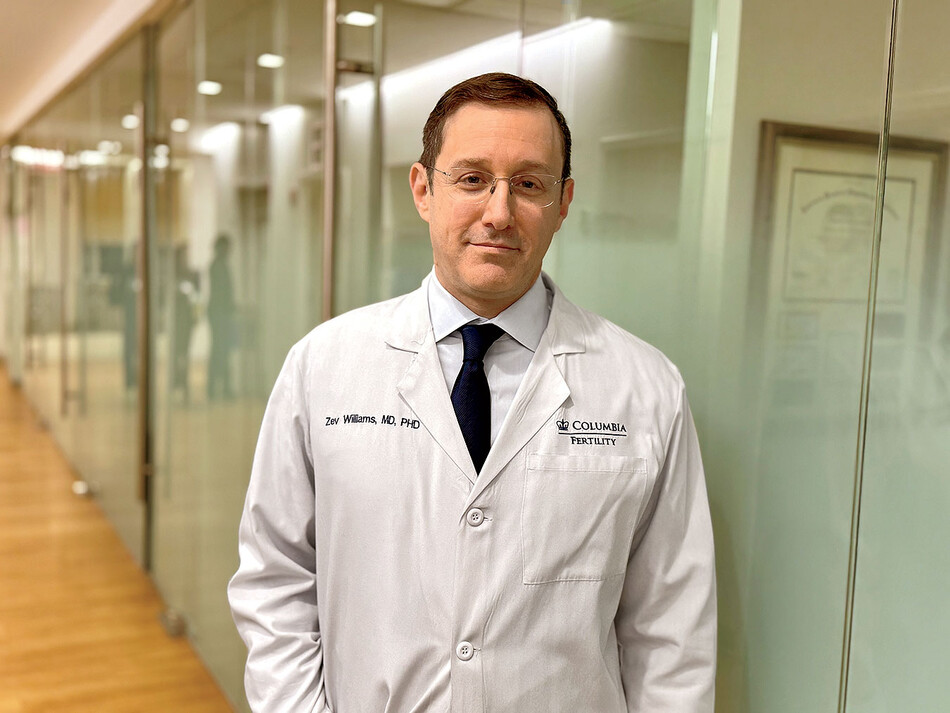
Zev Williams, a fifty-year-old native of Ottawa, became interested in recurrent pregnancy loss during his residency at Brigham and Women’s and Massachusetts General Hospitals in Boston in the early 2000s. What struck him first was the sheer complexity of the human reproductive system and how mysterious so much of it remained. “The number of things that must go right for a baby to be born, the number of physiological systems that must be coordinated — all with exquisite timing — is just extraordinary,” he says. “And I was astonished by how much we still didn’t know about it. The opportunities to contribute, both as a scientist and doctor, bringing empathy and comfort to people in pain, seemed limitless.”
Williams began treating people for infertility during his fellowship training at Weill Cornell Medical Center in 2008. He found the work deeply rewarding. “To help bring new life into the world, and all of the joy that accompanies that, is profound,” he says. “You’re thinking about not just that particular baby but also the children he or she might eventually have, and their children, and so on. It’s a remarkable thing to be involved with.”
Equally powerful, though, was witnessing the sorrow people felt when fertility medicine fell short. Williams says he can still recall one couple he cared for, early in his career, who had lost nearly twenty pregnancies. “I was part of a team that couldn’t figure out what was going wrong,” he says. “The couple was determined to keep trying, and all we could say was, ‘We’re sorry. We’re unsure how to help you.’ And that struck me as a terrible failure on our part. I thought, We have to learn to do better than this.”
Soon Williams was accepting patients who had been turned away by other doctors who told them that they would never be biological mothers. He also began applying for grants to study infertility and recurrent pregnancy loss. One study at a time, Williams and a circle of collaborators began filling in the gaps of knowledge that had long stymied the field. Several of their papers revealed that embryos communicate with the uterus in ways that scientists had never realized before, and that the timing and intensity of this molecular chatter could influence a pregnancy’s chances for success. Taken together, the studies helped to validate an idea that was still controversial at the time: that recurrent miscarriages weren’t just a matter of statistical chance but had biological roots that could be identified and treated.
Women who suffer miscarriages tend to feel guilty, ashamed, and socially isolated afterward.
At the same time, Williams grew troubled by how his patients often spoke about their losses. “It seemed clear that in the absence of medical explanations, they were turning inward for answers, punishing themselves with self-criticism.” So Williams began to study cultural perceptions of pregnancy loss, revealing how silence around the subject often leaves women to grieve alone. In one 2015 study analyzing national survey data, Williams found that American men and women wrongly assume that miscarriages are rare (in fact, 15 to 20 percent of pregnancies end in one) and that women who suffer miscarriages tend to feel guilty, ashamed, and socially isolated afterward. In lectures and writings that followed, Williams argued that doctors needed to show more empathy to patients, in addition to improving treatments for recurrent pregnancy loss.
By 2017, Williams’s research and advocacy had begun attracting national attention, including from Mary D’Alton, the chair of Columbia’s obstetrics and gynecology department. Under D’Alton, the department had already become known for providing innovative care to women with high-risk pregnancies, and she was then reimagining CUFC as a destination for similarly complex cases of infertility. When she met Williams, she says, their connection was immediate. “We agreed that by combining cutting-edge science and compassionate care, we could create the best fertility center anywhere,” she recalls. “And Zev was quietly confident about how to go about that. He had a real clarity and ambition of vision. I knew within minutes we’d found our new leader.”
On a Friday afternoon at the Columbia University Fertility Center, perched at the top of a Beaux Arts office tower in Midtown Manhattan, Zev Williams greets a visitor with the enthusiasm of a proud homeowner giving a tour. The space, which CUFC has occupied since 2018, feels more like a wellness spa than a medical facility. All the details, Williams explains, were chosen with care: the muted earth-tone walls that diffuse the natural light pouring in; the front desk, set at the right height for the average woman; the midcentury couches, voluptuous sculptures, and classic paintings that soften the usual clinical austerity of such places. Every element, he says, is meant to soothe and reassure. “Fertility care has such an emotional aspect,” he says. “We wanted to respect the vulnerability that so many people feel when they come in here.”
The front lobby is bustling, with patients checking in, nurses ushering them to egg retrievals and implantations, and couriers arriving with fluid samples. On one counter sits a stack of discreet white boxes: at-home semen-collection kits for men, who no longer need to provide samples in sterile clinic rooms, and pain-free home blood-collection kits for women, which are designed to spare them the daily in-office pricks once required to monitor hormone levels. This technology, Williams notes, grew out of CUFC’s research-and-development program, which aims to make fertility treatment not only more effective but more humane. “Women told us that they dreaded the constant needle jabs,” he says. “When we made that part of the process easier, more stayed in treatment, and success rates actually went up.”
On the floor above, the atmosphere shifts. Standing at lab benches, groups of scientists in white coats are pipetting, labeling, and loading samples into spinning centrifuges and imaging machines. This is the heart of CUFC’s research-and-development operation, where biologists, geneticists, endocrinologists, and others conduct experiments alongside lab technicians and clinical scientists who handle routine analysis of patient samples. “Having everyone in the same space sparks creativity,” says Williams. “The scientists get ideas about how to improve our procedures by observing and talking with the clinical staff.” At one station, a young lab worker named Yejin Bann sits before a computer monitor as black-and-white images flash by too quickly for the human eye to follow. She’s overseeing the STAR system — the AI-powered platform that analyzes semen samples, two thousand frames per second, to identify healthy sperm cells. Every so often, a blue box flashes on her screen, marking one that the algorithm has spotted. Bann pauses the feed to confirm. “We need to make sure it’s actually a sperm and not some debris,” she says. “But this is definitely a sperm. It looks like a strong one.”
Once cleaned and prepared, these sperm will be injected into eggs down the hallway in the state-of-the-art embryology lab. If all goes smoothly, this will make a father of a man who was previously told that his low sperm count made this impossible. In the past, his only option would have been to undergo a painful operation to remove tissue from one of his testicles in hopes that sperm could be extracted from it. But testicular biopsies don’t always succeed, and the Columbia team has shown that STAR works better. Williams and his colleagues recently made international headlines when a New York City couple who had been trying to have a child for eighteen years succeeded in getting pregnant using STAR.
“Usually a semen sample contains two to three hundred million sperm cells, but these patients may only have one or two. We only need one,” says Williams, who oversaw STAR’s development with Hemant Suryawanshi, a Columbia assistant professor of reproductive sciences.
STAR is perhaps the clearest example yet of CUFC’s mission to make infertility a curable condition. But just a few steps away, Williams’s colleagues are testing the next wave of ideas. One group is experimenting with a novel type of light therapy, called photobiomodulation, to see whether it can repair the oxidative damage found in certain embryos, including those derived from eggs of older women. Another is studying whether the drug rapamycin, a common immunosuppressant, might be used to slow the pace of ovarian aging and thereby delay menopause and extend women’s fertility a few years. Preliminary research indicates that this is safe and may even provide other health benefits, according to Williams, who is now enrolling participants in a large clinical trial with fellow Columbia medical researcher Yousin Suh. “The ovaries are endocrine organs that influence aging processes throughout the body,” says Suh, “so it seems that when you slow their aging, you slow aging everywhere.”
Of course, these experiments raise deeper questions about how we define infertility and how far medicine should go to try to extend the biological clock. As women and men age, the quality of their eggs and sperm declines, and studies have shown that children born to older parents — whether naturally or through IVF — face modestly increased risks of genetic and developmental disorders. Partly for this reason, most fertility centers set firm age limits: typically around forty-five for women using their own eggs and fifty for those using donor eggs. (Egg quality deteriorates much faster than sperm quality, making a woman’s age the more important factor.) Columbia’s center, by contrast, avoids rigid cutoffs, treating age as just one consideration among many in assessing a woman’s ability to carry a pregnancy and her prospects for having a healthy child. The Columbia clinicians say that being embedded within a major academic research hospital helps them to navigate these risks more thoughtfully and to work with patients to determine what is appropriate for them. “We’re in close contact with leading experts in many departments — from cardiology and nephrology to maternal-fetal medicine and genetics — who help us evaluate these cases on an individual basis,” says Forman, CUFC’s medical and laboratory director. The center also assesses the health of sperm, eggs, and embryos using some of the most sophisticated genomic-screening technologies available, including several of their own invention. And Williams is involved in efforts to develop new molecular methods of assessing women’s physical capacity for pregnancy. “A person’s chronological age is hardly a precise measure of their overall health,” he says. “Thanks to advances in genetics and epigenetics and our close collaboration with colleagues across Columbia’s obstetrics and gynecology department, we can now more accurately assess each patient’s risks and manage them before and throughout pregnancy.”
The cost of fertility treatments is another challenge. Each new molecular test, genetic screen, or advanced embryo assessment can add thousands of dollars to an IVF cycle that already costs $15,000 or more. And while a growing number of US health-insurance plans now cover IVF, they typically do not pay for the kinds of novel technologies that Williams’s team is developing. He hopes that will change as insurers recognize their long-term value. “If these tools reduce the number of IVF cycles that couples must go through to have a child,” he says, “it will lower the total cost of treatment and make it affordable to many more people.”
To date, most of the new diagnostic and treatment methods that Williams’s team has developed are used only at CUFC, but he expects that in time they will spread to other clinics and become part of standard fertility care.

Lauren and Andrew Citro are grateful for the Columbia care they received. In the summer of 2022, they welcomed their first son, Everett — a golden-haired boy who loves planets and asks endless questions — and two years later they brought home his little brother, Atlas, who is equally bright, with an adventurous spirit that delights and amuses his parents. “To say they are my pride and joy doesn’t cut it,” Lauren says. “They are my gems, and I’m obsessed with them both.”
No one can say for sure why the Citros’ story ended the way it did, given that the science of fertility is so complex. But Lauren followed the same multifaceted treatment that Williams recommended before conceiving both of her boys, and she soon plans to repeat the regimen in anticipation of what she hopes will be her third successful embryo transfer.
Asked what she might have done if Everett and Atlas hadn’t come along, Lauren pauses. “It’s hard to imagine. There would have been so much grief. But I’ve seen other people work through that pain and build fulfilling lives, and I think we would have been able to eventually.” She says it helped that Williams never promised her a baby. “That was ironic, because other doctors had given me false confidence, which made me feel like it was my fault when I lost my pregnancies.”
Williams says that one of the most difficult parts of his job is helping patients decide how long to keep trying to have biological children. Some will decide rather quickly — perhaps after an IVF cycle or two — to shift course. They may decide to use donor eggs or sperm, or a surrogate carrier, or they may choose instead to adopt or to devote themselves to nephews and nieces. But others will persist for longer than anyone around them can fathom, longer than reason alone can explain, searching for children they seem to feel already exist, if only they could reach them. And inevitably, in the course of that journey, some well-meaning friend or family member will gently suggest, perhaps only insinuating: Maybe nature is trying to tell us something — that it isn’t meant to be?
“And I totally reject that notion,” Williams says. “I don’t see infertility as nature’s way, or God’s way, of signaling that some people shouldn’t have children. The message isn’t ‘Give up.’ The message is, ‘Here’s an imperfect world. Here’s a person who is meant to be a parent, but something isn’t working the way it should. It’s our job to fix it.’”