The field of theoretical neuroscience, which uses computational models to predict neural activity in the brain, is relatively new. Twenty years ago, there were just a handful of practitioners scattered around the globe, and Columbia had two of them: Ken Miller and Larry Abbott. In 2005, Miller and Abbott started the Center for Theoretical Neuroscience (CTN), a collaborative research hub for unraveling the mysteries of the human brain.
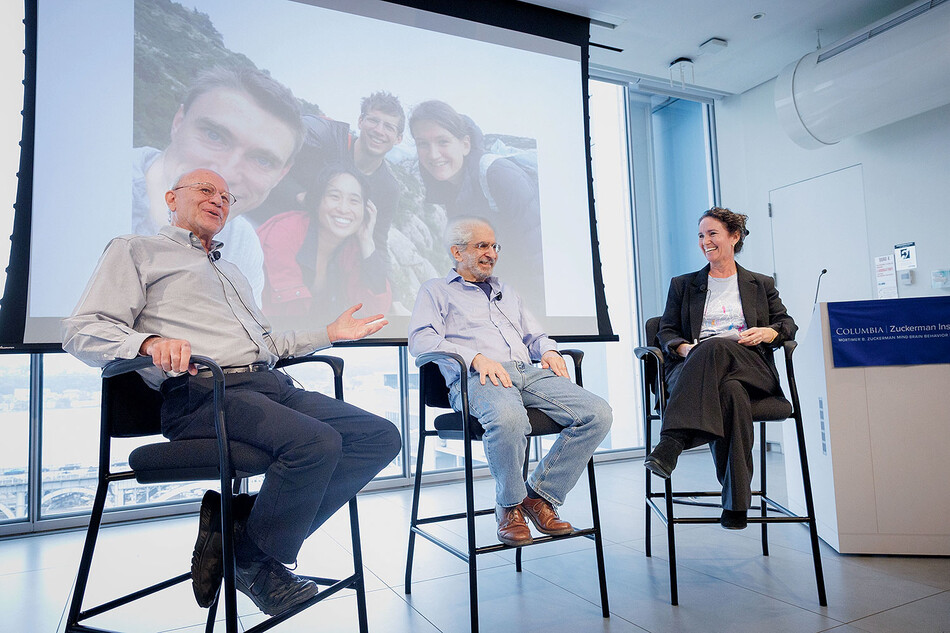
At first, no one studying the brain at Columbia — not even professors Eric Kandel and Richard Axel ’67CC, whose work on memory and olfaction, respectively, had earned them Nobel Prizes — really understood what Abbott and Miller were up to. Now, two decades and many algorithms and fruit flies later, the CTN founders sat together in a roomful of students and postdocs in the Jerome L. Greene Science Center in Manhattanville to reflect on their creation.
The event, moderated by Daphna Shohamy, director of the Mortimer B. Zuckerman Mind Brain Behavior Institute, was part of the second annual ZIFest, a two-day fair of talks and presentations by students, postdocs, and faculty, who shared their latest insights into the neuronal underpinnings of sensation, problem-solving, movement, memory, decision-making, and more.
Zuckerman may be a world-class neuroscience institute, but what really sets it apart is the CTN: just as physicists use mathematical models to predict the behavior of celestial bodies and elementary particles, Abbott and Miller — who both trained as physicists before turning to neuroscience — create data-based computer models to predict the behavior of neurons. This allows researchers to test and refine their theories and to riff on new concepts. “The model,” Miller said, “is a scaffolding for ideas.”
Ideas and collaboration are the heart of the CTN. Just as neurons stimulate each other and form networks, Columbians in neuroscience, cell biology, physics, mathematics, statistics, psychiatry, and engineering interact with each other at the CTN, exchanging ideas and scribbling on whiteboards in a free-flowing space devoid of social hierarchies.
The audience in the Greene Science Center heard descriptions of some of the CTN’s greatest hits: how neuroscience professor Stefano Fusi, who studies the brain’s computational mechanisms, and Daniel Salzman, a professor of neuroscience and psychiatry, created a model that can predict whether the brain has learned something new; how Fusi and Abbott, exploring memory storage in the brain, devised a model that allowed synapses (the gaps between neurons where information is transmitted) to absorb new memories while preserving old ones; and how Miller built a mathematical model that showed that the process of “inhibition” — when one neuron deactivates another — is essential for proper brain functioning.
Theoretical neuroscience has exploded since Miller and Abbott came to Columbia. “When we started this, I knew everybody in the field,” said Miller. Not anymore. Today, there are nine principal investigators and eighty people working at the CTN. The proliferation of big data and the sheer complexity of the brain have created a demand for theoreticians, many of whom employ AI to further their understanding of the workings of the brain, then apply their discoveries, in turn, to the improvement of AI.
Algorithms, neurons, and the mysteries of the mind: It can all get pretty obscure, and both Abbott and Miller confess that the work of their young trainees sometimes goes over their heads — and they love that. “We have to maintain the ability to be the stupid one in the room,” Abbott told the crowd with a smile, “when many of you are explaining your experiments.”
That’s how it was at the inception of the CTN, when the center’s purpose eluded even Eric Kandel. “But after about a month of being here,” Abbott said, “I was in my office, and Eric came down all excited, and he said, ‘I figured out what you guys do. You create ideas.’ It’s the best thing anyone could have ever said.”
This article appears in the Winter 2025-26 print edition of Columbia Magazine with the title "Big Brain Theory."