In 2021, at his fifty-fifth college reunion, held on Zoom due to the pandemic, Barry Coller ’66CC wondered about Professor Kesselman.
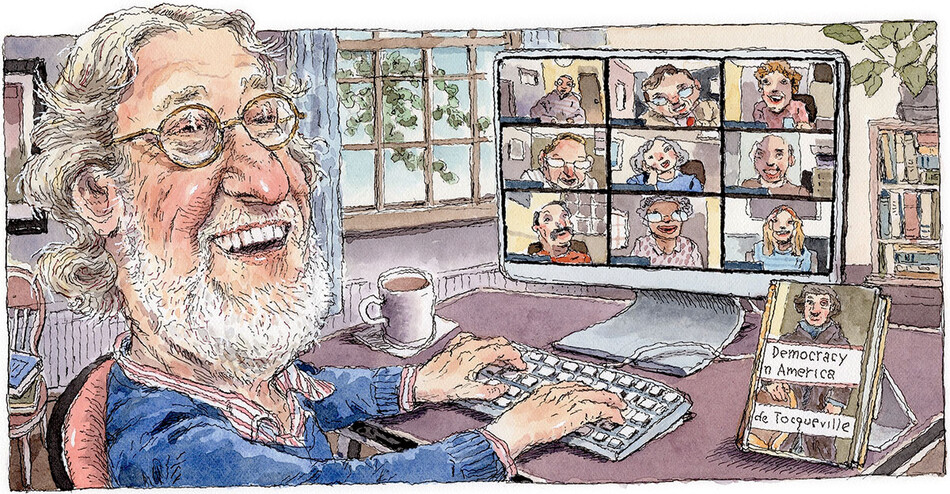
Coller rarely thought of college without thinking of Mark Kesselman. He had taken Kesselman’s seminar on local governance in his senior year and never forgotten it. Kesselman was twenty-seven then, a breath of fresh air on a faculty of older men who could remember having tea with Nicholas Murray Butler 1882CC, 1884GSAS. The Kesselman seminar was the opposite of stuffy. There was wine and cheese. Local politicians sat in. The class read Tocqueville, Robert Dahl’s Who Governs?, and Kesselman’s own studies of local French politics. Kesselman radiated a pure love of teaching, and Coller became a certified “Kesselmaniac.”
Now, at the reunion, Coller asked around: Was Kesselman still alive?
Kesselman was indeed alive, according to Neal Hurwitz ’66CC, who had been Kesselman’s first teaching assistant. Retired in 2007 after teaching at Columbia for forty-two years, Kesselman had since been busy writing about politics and lecturing in the US and in France. He lived in Massachusetts, where his wife was a professor at Amherst College, and he had two grown sons.
Now Coller and Hurwitz got to thinking: What if they rustled up others from the old seminar to meet and reminisce with Professor Kesselman?
The group met, and they had such a great time catching up and kvetching about autocracy that the next idea arose: Since Kesselman was still active — and with the US political system reeling from the first Trump presidency and the events of January 6, 2021 — why not rekindle the classroom spirit and hear from the professor himself?
In February 2022, Hurwitz organized a Zoom meeting with members of the Class of 1966 — and their professor. “I was very nervous,” Kesselman says. “I over-prepared, I’m sure. I wanted to do well.” His topic was the Federalist Papers, and how the system of checks and balances that authors Alexander Hamilton 1788HON, John Jay 1764KC, and James Madison had devised was meant to prevent tyranny, yet failed to stop Donald Trump. The reason, Kesselman explained, was because the system also relied on what Tocqueville saw as the cultural norms of American political functioning.
Nervous as he was, Kesselman — white beard, wire-frame glasses on his nose, mirthful eyes — was the picture of composure. At eighty-four, he looked younger than some of his students, who kept calling him Professor. He had to urge them to call him Mark.
Everyone loved the atmosphere and the company, and now Hurwitz had another idea: What if they did a real, ongoing seminar, with other speakers and topics? They certainly had the firepower. Coller, for instance, had been physician in chief at the Rockefeller University for twenty years. Kenneth Fox ’66CC was a historian. Gerald Friedman ’77CC was an economist. And they all knew people, particularly at Columbia, who could contribute.
Coller and Hurwitz took the lead as organizers, and in some sessions, as many as thirty people attended. Columbia political-science professor Ira Katznelson ’66CC lectured on US security policy. Coller and Friedman debated health-care policy. Fox spoke on affirmative action in light of Students for Fair Admissions v. Harvard. Daniel Kurtzer ’73SIPA, ’76GSAS, former US ambassador to Egypt and Israel, discussed Hamas and Israel, ten months before October 7, 2023. And amid the crises and controversies that roiled the Columbia community after October 7, the seminar, heavily male and Jewish (a reflection of 1960s demographics), held together, despite occasionally bitter disagreements. “Overall, civility has been maintained,” reports Fox.
To be sure, clashes of politics and personalities have made for raucous discussions. Many of the participants came of age socially and intellectually in a milieu of freewheeling, unedited exchanges, and it’s safe to say that not every utterance in the seminar adheres to modern academic speech codes. More than once, gentle Kesselman has had to pound the gavel.
Born in 1938, Kesselman grew up in Peekskill, New York. One of his formative memories was the 1949 Peekskill Riots, when performer and labor and civil-rights activist Paul Robeson 1923LAW was scheduled to sing at an outdoor concert. Before Robeson’s arrival, white supremacists attacked concertgoers with stones and bats, injuring 150. Social and economic justice became central to Kesselman’s worldview. At the University of Chicago he took a course on Marx with Leo Strauss, often called the father of neoconservatism. “Strauss is known as an ultraconservative, but he was his own person, and I thought he was brilliant,” Kesselman says. At Columbia, Kesselman’s signature course was The State in Advanced Capitalism. He also taught comparative politics and contemporary political theory.
Today, at eighty-eight, Kesselman is enjoying this unexpected ride. And he’s grateful to the seminar organizers — Hurwitz, Coller, and physicist Mel Siegel — for doing most of the driving: helping to find the speakers and running the show. “I’m taking more of a back seat,” Kesselman says. “I’m more of an informed commentator.” Recent guests, such as Columbia law professor David Schizer, who gave a frank and nuanced talk about campus antisemitism, and Maya Kornberg ’16SIPA, who discussed her book Stuck: How Money, Media, and Violence Prevent Change in Congress, attest to the seminar’s continued high level of scholarship and discourse.
Kesselman may still be “Professor” to some, but the seminar allows him to be a student too. “It’s been very stimulating,” he says. “And I’ve learned a lot.”
This article appears in the Fall 2026 print edition of Columbia Magazine with the title "Class Consciousness."