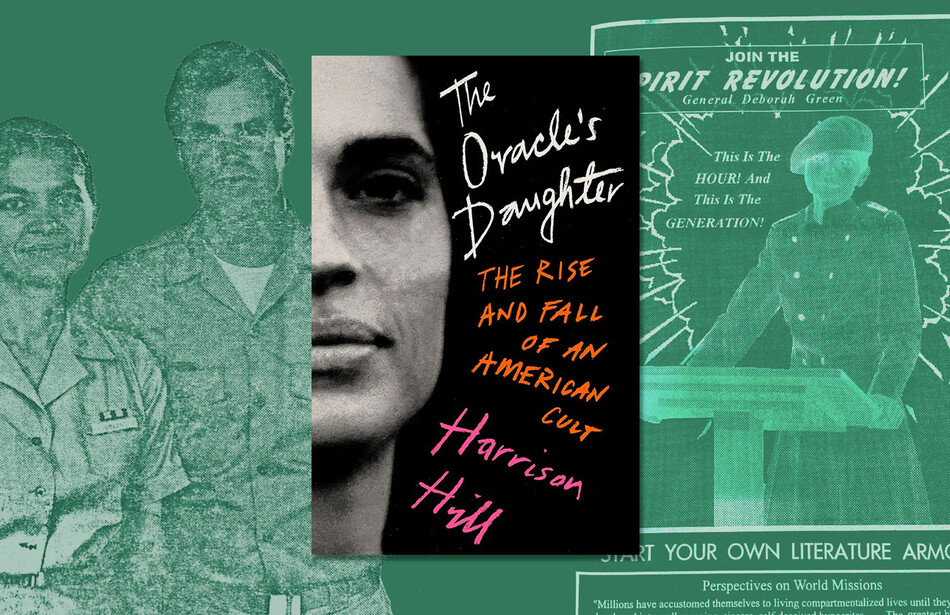
In his new book, The Oracle’s Daughter, Harrison Hill ’19SOA traces the story of the Aggressive Christianity Mission Training Corps (ACMTC), a woman-led paramilitary religious cult that was founded in 1980s California before settling in rural New Mexico.
How would you describe the ACMTC’s beliefs and its restrictions on members’ lives?
ACMTC members believed they were soldiers in what they called “God’s Army.” Exorcism was central to daily life in the group, as was prophesy and speaking in tongues. Much of the outside world was seen as evil, from television and yoga to tight jeans and abortion. Members cut off contact with friends and family members on the outside and had little to no exposure to the world beyond the group. They were often denied food and medical treatment; Some members claimed they were subjected to extensive physical and sexual abuse. At the center of it all was the cofounder and leader, Deborah Green, a self-proclaimed prophet who claimed to have a singular connection to God.
The book got its start as a feature article for The Cut that followed how Sarah Green, the daughter of ACMTC founders Deborah and Jim Green, escaped the group’s New Mexico desert compound at age twenty-six in 1999. Is Sarah’s experience of indoctrination and escape typical of cult members?
No, she’s unique in a couple of ways. First of all, she never “joined” the ACMTC. She was in the group because her parents founded it, and that happened after Sarah had been in the regular world for a number of years, so she had a taste of what existed before. She also had a vision for what her life might be like outside of the group. I think her particular situation comes down to personality and character. Her brother had very similar upbringing, but he stayed in the ACMTC.
More often, when someone leaves a cult, it’s because they’ve had a blip of exposure to the outside world that offers a peephole into what they’ve been missing. If they leave a compound and spend a fair amount of time with experts or family members who can show them what’s contradictory about the cult’s philosophies, the speed at which a person can change is surprisingly fast. That was something that really surprised me in learning about these groups.
The ACMTC is pretty small, with only around 100 members at its peak, but you demonstrate how it intersects with currents in American religious culture — from Deborah styling herself as a prophet in the vein of Ann Lee of the Shakers to pastor Jerry Falwell declaring that evangelicals were “fighting a holy war” the year before the Greens founded the group. How did you come to trace and contextualize the ACMTC within a larger history?
When I started writing my article for The Cut, I wasn’t thinking about the broader historical resonances. But over the course of doing that reporting, certain themes started to emerge. The more I read, the more I realized that ACMTC is like the Forrest Gump of cults — it just always happens to be there either literally, or its story resonates in a sociopolitical, religious way, not just contemporaneously, but also throughout American history.
One of the major themes that keeps coming up throughout the book is the porous boundary between fringe belief groups and more mainstream religious circles in America. Why was it important for you to explore that phenomenon?
I came into the project questioning the similarities between cults like ACMTC and more traditional religious sects. When I started my research, it became immediately apparent that what I would call “pseudo-Christian far-right groups” engage in similar rhetoric to ACMTC. I think seeing something taken to its absolute extreme helps shine light on beliefs and practices that maybe aren’t quite as extreme but can be nonetheless destructive.
It was very important to me, however, that this book not be condescending toward people who practice religion in a more loving and additive way to society. Faith can be beautiful and meaningful, and it does not need to lead to abusive or hateful practices. It’s like every other phenomenon in the world — it can go in a destructive way or a productive way.
It took until 2017, when Deborah Green was arrested on child sex-abuse charges and Jim Green pled no contest to abuse charges the following year, for the leaders of the group to face any legal repercussions, despite years of outcry about the grievous abuse of members, including children. Why is it so difficult in the United States to bring cult groups to account in a legal setting?
In order to bring down a cult under the American legal system, you need to prove that the leaders and members have engaged in crimes in a way that will stand up in court. You can’t just persecute people for having strange beliefs or spreading hateful messaging.
It comes down to the First Amendment. We have a very specific and expansive idea of what religious freedom means, and in a lot of ways, that’s a good thing. It’s one of the founding ideas of the country. It means that people have a freedom that is really not available to them in other parts of the world, even in some other Western democracies. But that also means people have more opportunity to go off the deep end, so to speak.
There’s also a real resistance from law enforcement to prosecute religious groups, because they don’t want to be seen as stepping on a fundamental freedom. Some of this hesitance dates back to the 1993 Waco siege, when federal authorities violently and tragically bungled their operation against the Branch Davidians cult and were subsequently chewed out by officials in congress. The fallout understandably scared a lot of law-enforcement officials around the country. Since Waco, there’s been a kind of cloud hanging over attempted cult crackdowns, which can delay justice even when the evidence of wrongdoing is clear.
How do you see the story of the ACMTC as a particularly American story?
I think it’s an American story in that it shows some of the costs of religious freedom. There’s also the very American idea of pushing West — starting something new, beginning again — that’s foundational to the character of the nation. ACMTC represents that value in some ways: They started in Sacramento, California, and they embodied a similar sense of novelty and upstart energy that led to counterculture movements and the rise of Silicon Valley. When they were forced to flee into the New Mexico desert, they further embodied that idea of a westward push (despite technically moving eastward). They were beginning afresh. They wanted to create a model society for the rest of the world, and that that is a particularly American kind of thing.