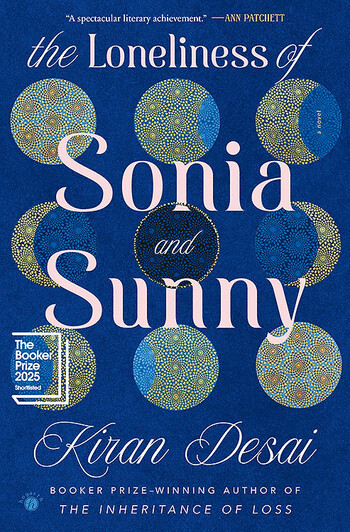
The Loneliness of Sonia and Sunny, by Kiran Desai ’99SOA, is a novel so oceanic in its scope and depth, so protean in its modes, that the reader’s first delicious plunge feels astonishingly direct. We begin with Mina Foi, a middle-aged aunt at once defined by loneliness — returned to her parents’ home after a disastrous marital experiment — and bound to relentless company in a family and city (Allahabad, India — today’s Prayagraj) that “had no patience” for the feeling. Thoughts of Wordsworth’s wanderings “lonely as a cloud” produce fits of laughter from her father.
Though we are introduced to Mina first, it is the loneliness of her niece Sonia that becomes the novel’s principal concern, a condition that surpasses the family’s understanding so entirely that every remedy they suggest — from jumping jacks to desserts to the prospect of an introduction — seems clownish, bound to isolate Sonia even more during her last college winter in Vermont.
At first, Sonia, an insightful reader and writer, appears to find her own way forward. She tumbles into an affair with an older painter, Ilan, who offers Sonia various initiations — sushi, sex, shopping — alongside more dubious ministrations: a gallery job in New York that solves the problem of her visa but puts her firmly in his power, as well as glib advice about writing, which makes her doubt her own work. When his narcissism tips to abuse, Sonia learns another kind of loneliness, a loss of self so devastating that “she was simply not there.” Eventually she consents to her grandfather’s idea to meet the grandson of his chess rival.
The proposed introduction is to Sunny Bhatia, a night-shift copy editor and “brooding type” whose nickname has not succeeded in lightening his spirits. Sunny is coping with loneliness of his own — in his relationship with his Midwestern girlfriend, Ulla, whom he has kept secret from his family; in the uncertainties he feels as a journalist, a career that has left him mystified by both India and the United States; and most powerfully in his uneasy position as an immigrant: “His life now seemed at a remove, … sometimes unrecognizable to himself. … He became an impostor, a spy, a liar, and a ghost.” He rejects the introduction, forwarded to him as a bit of sly comedy by his mother (who reports that they are “the target of an intrigue”) but received by Ulla as a blow, disrespectful both to her and to the “poor girl who is being marketed.” When Sunny and Sonia finally encounter each other on a train to Allahabad, it’s by chance, although Sunny’s friend Satya might insist, “Fatalistic life!”
This is Desai’s first novel in two decades, since she won the 2006 Man Booker Prize and the National Book Critics Circle Award for fiction for The Inheritance of Loss. Now she has given us a novel so magnificent that it might contain every kind of loneliness: the loneliness of a woman who loved only once and wonders if “it was too much to ask to be loved all the way through life”; the loneliness of a widow who never loved her husband but bargains with his spirit to love him after all if he will remain; the loneliness of a mother who heads for the hills, thinking, “Loneliness could mean abiding peace.” The loneliness of servants and cooks, of writers and mystics, of anonymity and celebrity, of the betrayed and the abandoned. The appalling, often dangerous loneliness of men who are not the center of attention. The loneliness of an immigrant whose patient prefers to die waiting for a white doctor and the loneliness of the emigrant who tries to return. There is the loneliness of modernity, of receiving a green card and feeling unable to tell a soul. There is a loneliness so profound that a man does not wander as a cloud but becomes one, disappearing forever, leaving a cloud demon in an amulet to serve as his granddaughter’s guide.
Not every character summons the courage to overcome such loneliness. But there is boldness in abundance, both in the lives of the characters and in the writing itself. Desai never resorts to the stylistic conventions of loneliness: threadbare language, restrained elegance. Her language is as exuberant as the teeming world of the novel, which flows from romance to ghost story, from the mythic to domestic drama, from crimes to glorious meditations on art and literature. When Sunny describes “the exhilaration and fear of hundreds and thousands of stories crossing paths with his,” readers will feel the triumph of Desai’s accomplishment; through the miracle of this novel, dozens of those stories already belong to us all.