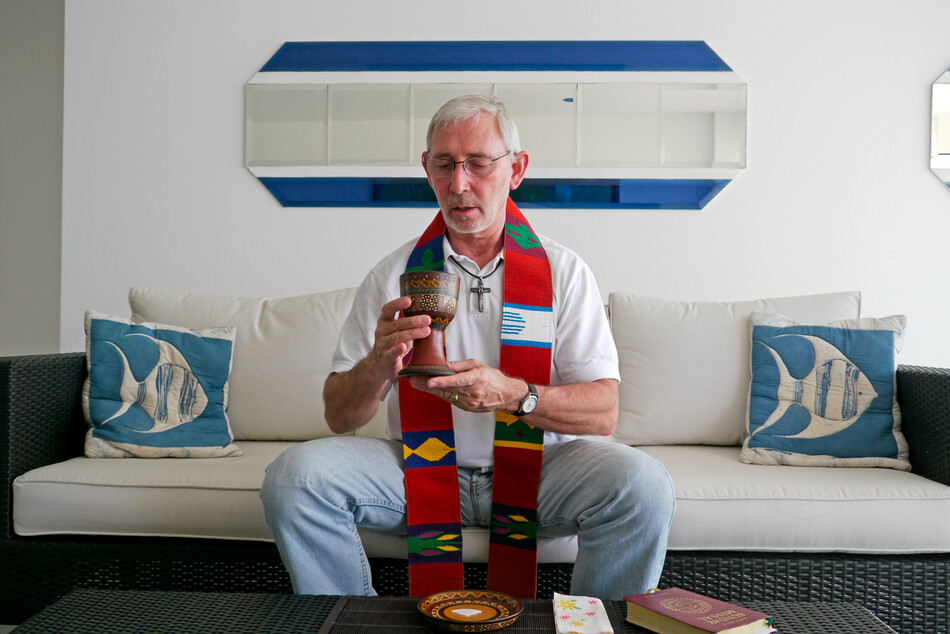
Father Joseph Fedora ’96JRN doesn’t have a traditional pulpit. The shantytowns of Lima, Peru, are his parish. Here the poor live in flimsy houses along unpaved roads, with inadequate sanitation, health care, and food — a stark contrast to the nearby gated communities of mansions overlooking the Pacific, not far from bustling boardwalks lined with tourists.
Usually dressed in a T-shirt and jeans with a silver cross around his neck, Padre José, as the locals call him, pays regular visits to homes, hospitals, and prisons to offer spiritual guidance as well as material help. “I rarely wear a collar,” he says. “It scares people. When they see a priest, they think, ‘I’m about to die.’”
Fedora leads the Lima ministry of Maryknoll Fathers and Brothers, a Catholic missionary organization headquartered in Westchester County, New York, that supports impoverished communities in sixteen countries, in part by providing health care. Since relocating to Peru full-time in 1998, Fedora has lived among the poor and worked primarily with people suffering from HIV and AIDS, including gay men, transgender women, and sex workers. “I don’t judge them, because I haven’t walked in their shoes,” he says. “The virus doesn’t discriminate, but the most affected here are poor gay men rejected by society. We show that the Church is present and walking with them.”
While more than a hundred thousand people in Peru are living with HIV or AIDS, Fedora estimates, that number is a fraction of the cases that existed when he began his ministry. The antiretroviral “triple cocktail,” introduced in the US in 1996, became available in Peru in 2004, thanks in large part to Fedora’s advocacy. “We protested for access to these drugs,” says Fedora, who lobbied government officials and participated in demonstrations with health-care and AIDS advocacy groups, as well as families of victims.
Still, the virus has devasted communities. Fedora recalls offering the sacrament of anointing the sick to a farmer emaciated by AIDS and disfigured by leprosy who had traveled from the jungle to seek solace and acceptance. “My job is to alleviate the suffering,” says Fedora.
To honor dead parishioners, he jots down names and a few words in a notebook he calls “the litany of saints.” The book has hundreds of entries. Some are for children. He remembers one man, half paralyzed from an AIDS-related stroke, forcing his left hand to move his right hand to make the sign of the cross. “Those bedside visits were some of the most powerful moments for me,” Fedora recalls.
Raised in Pomona, California, Fedora grew up with seven siblings. His mother managed their home while his father, a former boxer, ran a shoe store and later worked as a stockbroker. An altar boy, Fedora felt a calling to the priesthood when he was ten and went on to spend eight years in seminary, including four at St. John’s Seminary College in Camarillo, where he majored in philosophy. A 1972 trip to Mexico to build canals for Indigenous people led him to humanitarian work. “That experience changed my life,” he says. Joining Maryknoll in 1975, Fedora took courses there in theology and Spanish before being dispatched to Peru to work with poor farmers. Father Robert Francis Prevost — known today as Pope Leo XIV — was also stationed in Peru at that time, with the Order of Saint Augustine. “If we were to meet, we’d have a lot in common,” Fedora says.
Fedora returned to California in the 1990s to promote Maryknoll’s missions while serving as chaplain for the nonprofit AIDS Project Los Angeles. A colleague noticed Fedora’s strong communication skills and urged him to apply to journalism school, where he could hone the art of interviewing and reporting and channel it into his work at Maryknoll. He resisted at first but ultimately came to Morningside Heights. “My time at Columbia was challenging,” he recalls. “I was forty-two years old and learning something totally new. During the first semester, students from other disciplines presumed I was a professor.” After graduating in 1996, Fedora put his journalism skills to work in a new position, serving for several years as the associate editor of Maryknoll magazine — a century-old publication that covers the organization’s missions — and then reporting for the magazine part-time while focusing on mission work.
In recent years, with the AIDS crisis fading, Fedora has expanded his ministry in Lima to serve other communities in need, including victims of abuse and sex trafficking. During the COVID-19 pandemic, he led Mass and retreats virtually and sent daily messages of hope via WhatsApp.
In 2023, Fedora was diagnosed with lymphoma, which he says his doctors now consider cured. During his illness, the compassion he has spent a lifetime showing others was returned. “I had an army of people in Peru praying for me,” he says. Now seventy-two, Fedora is contemplating retiring in the next few years. The number of AIDS deaths has dwindled. So have his journal entries. “It’s rare I add to the book now,” he says.
This article appears in the Winter 2025-26 print edition of Columbia Magazine with the title "Compassion in Action."